
Management Is Not a Support Service. It Is the Operation.
There is a persistent misunderstanding about what villa management means in Ibiza, and it costs owners money every season. The misunderstanding is this: that management is something you add to a villa once the important decisions, such as buying, furnishing, and listing, have been made. A support layer. A convenience. Something that handles the logistics while the villa does the work.
In today’s Ibiza market, that framing is wrong in a way that matters financially. Management is not the support layer. In most cases, management is the operation. It determines how the villa is priced, how it is presented, how guests experience it, how compliance is maintained, how maintenance is handled, and ultimately whether the asset performs or disappoints. Two comparable villas in the same location, priced similarly, with similar guest profiles, can produce meaningfully different financial results purely based on management quality. We see this directly, every season.
The shift happened because the market got harder. When Ibiza was an easier rental environment, with lower acquisition prices, lighter regulation, and less professional competition, average management produced acceptable results. Today, with yields compressed, enforcement active, and guest expectations shaped by global luxury benchmarks, average management produces below-average results. The villas that perform consistently are operated with the same discipline and structure as a small boutique hotel, just without the front desk.
What a Villa Management Company Actually Does
The practical scope of professional villa management in Ibiza is broader than most owners realise when they first engage a company. A full-service operation covers every element of the rental cycle, from pricing decisions made months before the season to financial reporting delivered after it ends.
Day-to-day, professional management responsibilities include dynamic pricing and revenue management: adjusting rates based on demand signals, booking windows, and competitor movement to maximise income without eroding rate integrity. It includes multi-channel marketing and distribution, managing listings across direct booking platforms, agencies, and the villa’s own channels with consistent positioning. Guest communication runs from initial enquiry through check-in, in-stay support, and check-out, with concierge coordination for additional services woven through.
On the operational side, management coordinates cleaning and linen services to luxury standard at every turnover, oversees maintenance contractors and technical systems, manages emergency response around the clock during the season, and handles the regulatory compliance requirements, including guest registration, license monitoring, and certificate renewals, that the legal framework demands. Financial reporting to the owner covers income, costs, occupancy, and performance against targets, delivered on a schedule that gives owners real visibility without requiring them to be physically present.
That is a substantial scope of responsibility. It is also why the distinction between genuine full-service management and partial or fragmented arrangements matters so much in practice.
Full-Service vs Partial Management: The Real Difference
The choice between full-service and partial management is one of the most consequential decisions a non-resident owner makes, and it is frequently underestimated at the point of engagement. Partial management arrangements split the work: one company handles marketing, another handles cleaning, a third handles maintenance, and the owner coordinates between them from abroad. They appear cheaper on paper. In practice, they fragment accountability in a market where accountability is everything.
When something goes wrong in a partial management setup, such as a guest complaint, a maintenance failure, or a compliance inspection, the question of who is responsible rarely has a clean answer. Each party points to the boundaries of their remit. The owner, sitting in another country, becomes the de facto coordinator of a crisis they are not equipped to manage remotely. The cost of that coordination failure, measured in lost bookings, poor reviews, and reactive emergency spending, almost always exceeds whatever savings the fragmented arrangement appeared to offer.
Full-service management concentrates responsibility. One point of contact, one set of processes, one party accountable for the overall performance of the villa. That concentration is worth paying for. It produces better outcomes in a market where the margin for operational error has narrowed significantly, not because it is more convenient.
| Full-Service Management | Partial / Fragmented Management | |
|---|---|---|
| Single point of accountability | Yes | No, split across providers |
| Pricing & marketing control | Unified | Often separated |
| Emergency response | Coordinated, single contact | Depends on which party is responsible |
| Compliance oversight | Integrated | Often falls to owner |
| Owner involvement required | Low | High, owner coordinates gaps |
| Cost appearance | Higher headline fee | Lower headline fee |
| Actual cost in practice | Predictable | Often higher once gaps are filled |
| Best suited for | Non-resident owners, licensed villas | Owners with significant local presence |

Boutique Local Management vs Large Agency: An Honest Comparison
This is the comparison most owners should make more carefully than they do. The Ibiza villa management market contains everything from individual operators managing a handful of properties to large international agencies with portfolios running into the hundreds. Both models exist for a reason. But they produce different outcomes, particularly for owners who are not on the island and who are managing premium assets that require consistent attention.
Large agencies bring scale advantages: broad marketing reach, established brand recognition in source markets, and the infrastructure that comes with processing significant booking volume. For owners whose primary concern is maximum exposure and who are comfortable with a more standardised service model, a large agency can deliver volume and visibility effectively.
What large agencies structurally cannot deliver is intensive individual attention. When a company manages 150 or 200 villas across an island, the operational bandwidth per property is mathematically constrained. Pricing decisions become templated. Maintenance issues compete for contractor access across a large portfolio. Owner reporting becomes standardised rather than specific. Guest issues are handled by a team rather than by someone who knows your villa personally.
At Domundos, we made a deliberate decision to manage a small number of properties intensively rather than scale volume. That decision means every villa we manage gets the same level of attention in August that it gets in March. It means we know the individual quirks of every property: the air conditioning unit that needs checking before peak season, the access road that requires briefing for first-time guests, the contractor relationship that ensures emergency response within an hour rather than a day. That knowledge does not exist in a large portfolio operation. It cannot. The scale prevents it.
| Boutique Local Manager | Large International Agency | |
|---|---|---|
| Attention per property | High, limited portfolio | Lower, volume operation |
| Owner relationship | Direct, personal | Account management structure |
| Local knowledge depth | Extensive | Variable |
| Marketing reach | Focused, quality-driven | Broad, volume-driven |
| Pricing approach | Tailored per property | Often templated |
| Emergency response | Fast, direct contractor relationships | Depends on coordination chain |
| Flexibility | High | Lower, standardised processes |
| Best suited for | Premium villas, non-resident owners | Owners prioritising volume exposure |

Seasonal vs Year-Round Management: Why the Off-Season Matters
Ibiza is a seasonal destination, but villas are not seasonal assets. They exist twelve months a year, and what happens in the eight months outside peak season has a direct bearing on how the villa performs during it.
Year-round management means preventative maintenance is planned and executed while contractors are available and costs are predictable. It means compliance obligations, such as certificate renewals, license monitoring, and regulatory updates, are tracked continuously rather than scrambled before the season opens. It means security checks, system monitoring, and pre-season preparation happen on a schedule rather than as a reaction to the calendar.
Seasonal-only management can work, but it demands a level of personal owner involvement during the off-season that most non-resident owners are not positioned to provide. Villas that are genuinely unattended between October and April deteriorate faster, cost more to bring back to standard, and start the season already behind. In a market where the first guest reviews of the year set the tone for the rest of it, arriving at May in poor condition is an expensive way to begin.
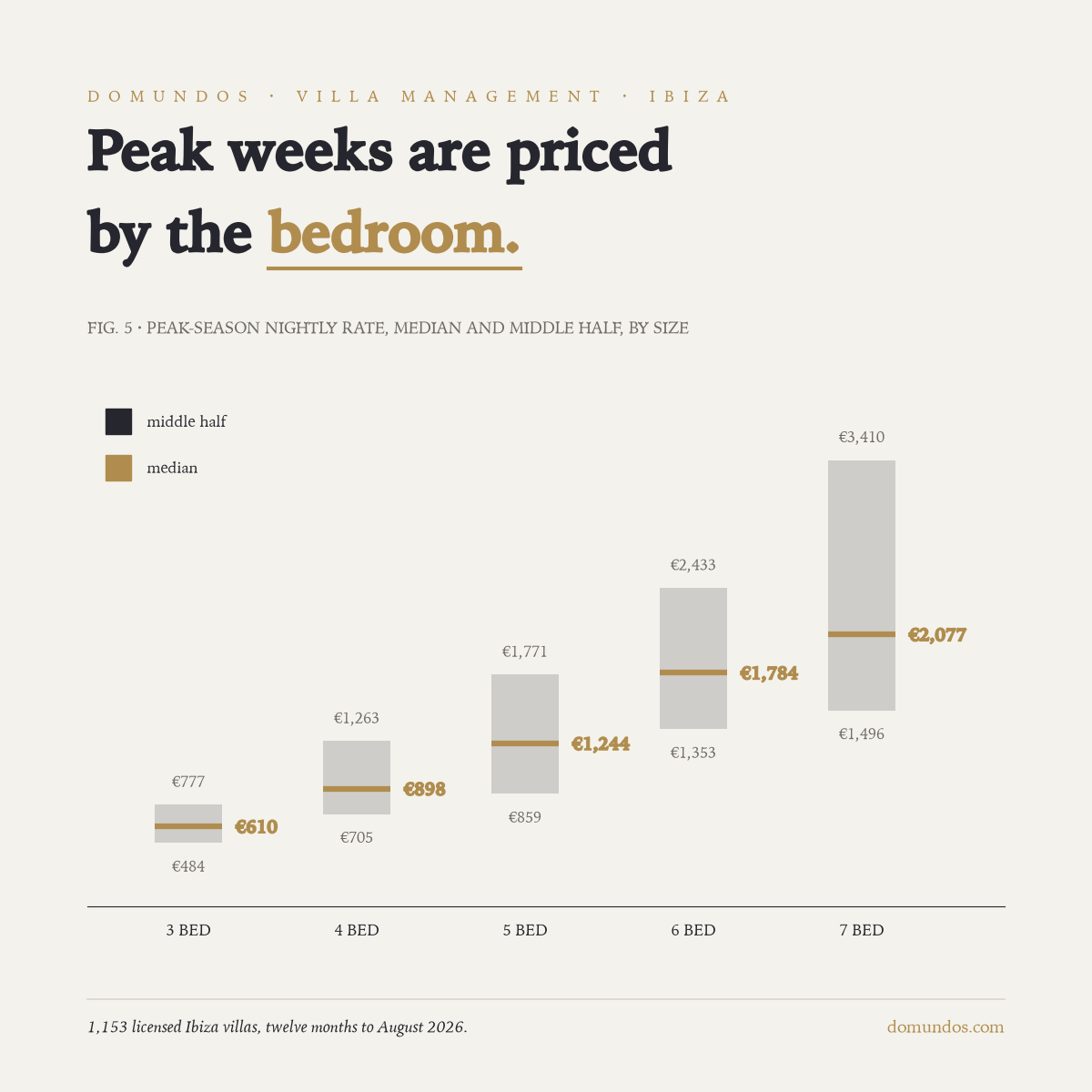
Pricing starts from the bedroom count: in 2026 the median peak-week rate was €898 a night for a four-bedroom licensed villa and €1,244 for five bedrooms, with the middle half of the market running from roughly a quarter below those medians to a third or more above them. Where a villa lands inside that band is the management’s work: presentation, reviews and rate discipline.
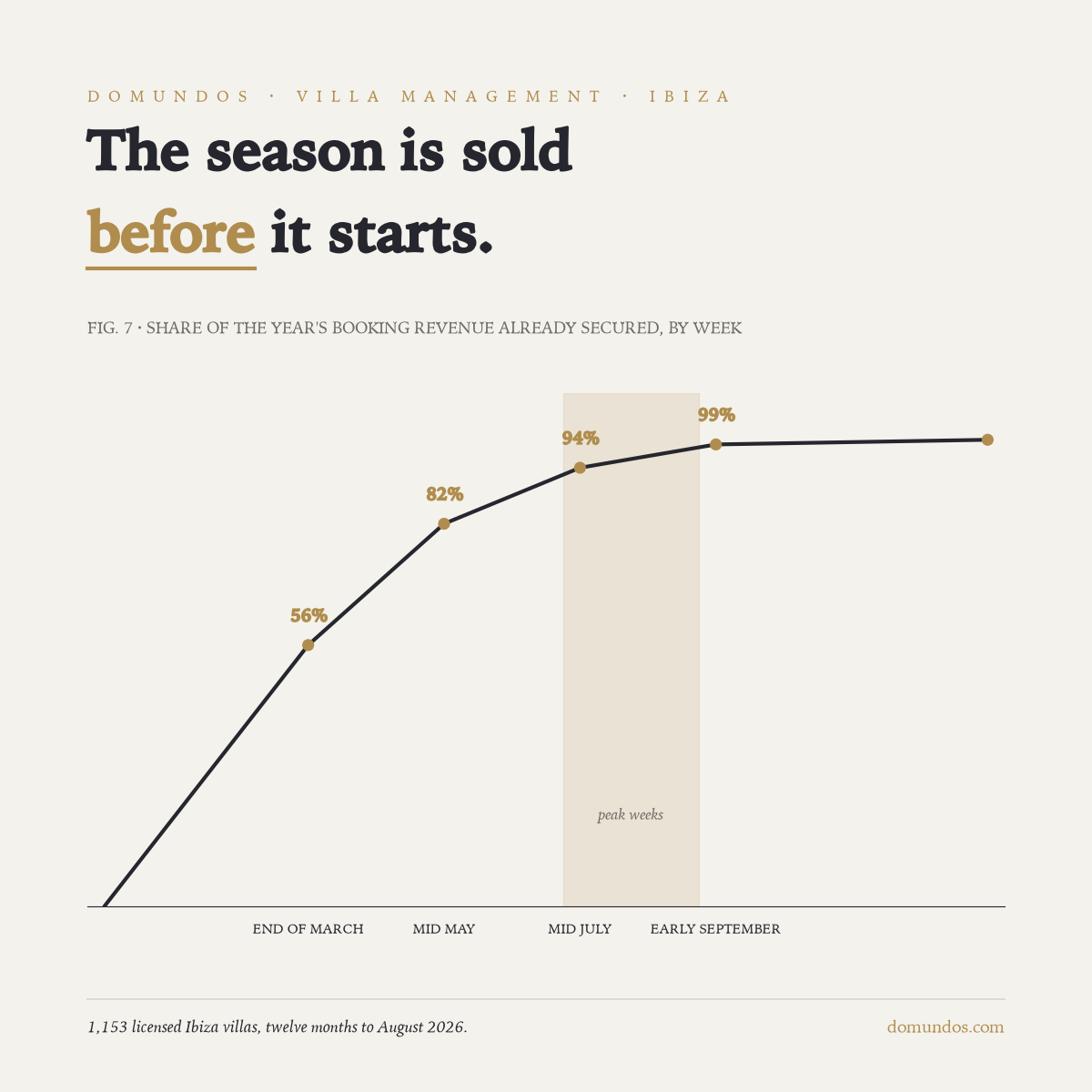
Timing matters as much as price. Across 1,153 licensed villas, 56% of the year’s revenue is booked by the end of March and 94% by mid-July, so the calendar has to be priced, photographed and visible on every channel before spring, not polished in June.
Owner Access, Transparency and Reporting
Transparency is a baseline requirement of good management, not a feature. Owners who do not have regular, detailed visibility into what is happening inside their villa cannot make informed decisions about pricing, investment, or management performance. In a market where margins are tighter and compliance risks are higher, operating without clear reporting is a financial risk, not just an inconvenience.
Professional reporting should cover occupancy achieved versus targets, rates obtained versus market benchmarks, revenue, costs broken down by category, maintenance activity and outstanding issues, guest feedback, and compliance status. This information should arrive on a predictable schedule, not be available only on request or delivered in formats that obscure more than they reveal.
Owners who receive genuinely transparent reporting make better decisions. They identify underperformance early. They understand where costs are running high. They can evaluate whether their management company is delivering value or simply processing bookings. In today’s Ibiza market, that visibility is one of the most valuable things a management relationship can provide.
