
Why Location Is the Most Misused Word in Ibiza Property
The short answer: the south-west earns the most. A five-bedroom licensed villa in Sant Josep de sa Talaia earned a median €137,000 in the twelve months to August 2026, against €103,000 in Santa Eulària and €89,000 in Sant Joan. But the numbers also show why “location” is the most misused word in Ibiza property: the spread between a median villa and a top-quartile villa inside the same municipality is larger than the spread between municipalities. Here is how the areas really perform, in numbers and from running villas in them.
Every agent in Ibiza will tell you that location is everything. And in the way they mean it, namely prestige, views, and postcode, they are partially right. But location as most buyers understand it is an incomplete and sometimes actively misleading framework for evaluating rental performance. Some of the most visually spectacular, apparently premium-located villas on the island are consistent underperformers. Some of the less obviously glamorous locations produce the most reliable, high-occupancy rental results season after season.
The reason for this gap is straightforward once you have spent enough time actually operating on the island rather than just buying and selling on it. Rental performance is driven by a combination of factors, including accessibility, guest logistics, proximity to infrastructure, licensing eligibility, and operational manageability, that do not appear on any property listing. A villa with a breathtaking clifftop position and a ten-minute unmarked track for access creates a different guest experience in August, when six people are arriving with luggage after a long travel day, than it does during a quiet April viewing with an agent.
At Domundos, we have managed villas across multiple areas of Ibiza over several years. What follows is an honest assessment of how different locations actually perform as rental assets: commercial properties that need to generate consistent income, attract repeat guests, and be operationally manageable across a compressed summer season, not lifestyle aspirations.

The Areas That Consistently Deliver Rental Performance
Rental performance in Ibiza clusters around a specific combination of attributes. The best-performing areas offer central access to multiple guest destinations, established year-round infrastructure, strong road connectivity for service and logistics, and broad guest appeal that extends beyond a single demographic or travel style. Here is how the main areas break down from an operational rental perspective:
Santa Gertrudis sits at the geographic heart of the island and is, in our experience, one of the most consistently strong-performing rental zones. Central location means guests can reach the north, south, east, and west coasts in comparable journey times. The village itself offers genuine character, such as good restaurants, a functioning local community, and year-round activity, without the noise and congestion of the coastal zones in peak season. Villas here attract a broad spectrum of guests from families to couples to groups, which supports stronger shoulder-season occupancy than more specialist locations.
The San José and Cala Jondal corridor is where Ibiza’s luxury beach club culture concentrates. Proximity to Cala Jondal, Blue Marlin, and the road network connecting to Es Cubells and the south creates a premium positioning that supports high weekly rates for well-managed villas. Guest profiles tend toward the higher-spending end of the market, which drives strong peak-week revenue. The operational challenge here is access: some areas have genuinely difficult road conditions that create logistical friction for cleaning crews and maintenance teams during high turnover periods.
Santa Eulària has repositioned itself significantly over the last several years and now represents one of the most attractive areas for extended-season rental performance. Family-friendly infrastructure, a proper town with year-round amenities, a marina, and strong restaurant options mean that villas here often attract bookings into October and from as early as April. This shoulder-season extension makes a material difference to annual income when costs are running twelve months a year.
Ibiza Town and Talamanca attract a different guest profile: guests who want proximity to the marina, Old Town dining, and nightlife access without being inside the noise. Well-positioned villas in Talamanca specifically have consistently performed at the higher end of occupancy benchmarks because they offer both lifestyle proximity and a degree of residential quiet. The trade-off is that properties here tend to be smaller and acquisition prices are high relative to rentable space.
West Coast sunset zones, the area broadly running from Cala Conta through to San Antonio’s quieter residential edges, command a seasonal premium built entirely on the sunset brand. Weekly rates during peak summer can be strong for villas with genuine unobstructed western orientation. The risk is that this brand is narrower than it appears. Guests who come specifically for sunsets and beach club culture are intensely seasonal, and shoulder-season demand drops faster here than in more versatile central locations.

Where villas earn most: the numbers
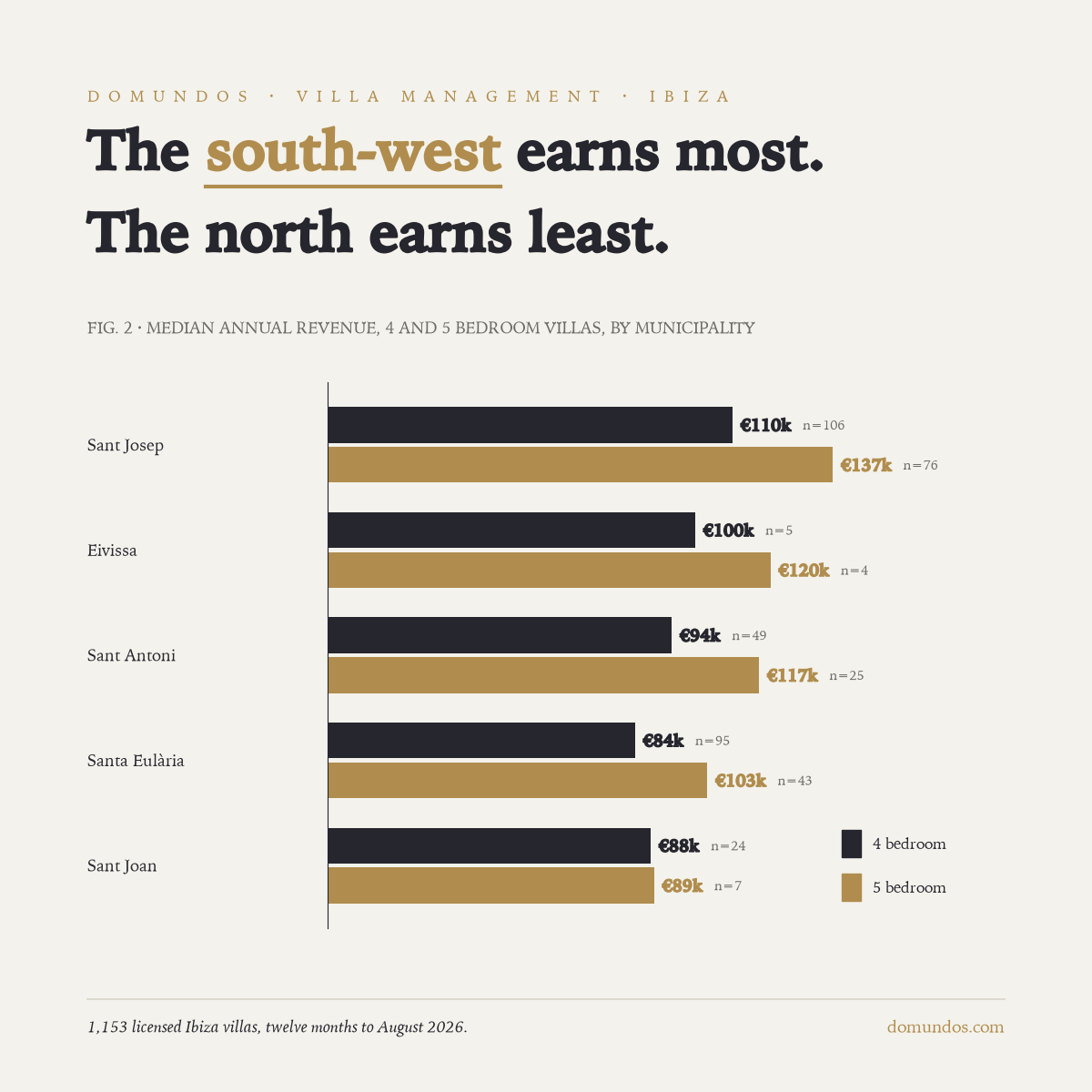
The island has five municipalities, and the rental data sorts them clearly. For a four-bedroom licensed villa the median annual revenue was €110,000 in Sant Josep de sa Talaia (which includes Cala Jondal, Es Cubells, Cala Conta and most of the south-west), €100,000 in Eivissa (Talamanca and the town), €94,000 in Sant Antoni de Portmany (the west coast sunset zones), €88,000 in Sant Joan de Labritja (the north) and €84,000 in Santa Eulària des Riu (Santa Gertrudis, Roca Llisa and the east). At five bedrooms: €137,000, €120,000, €117,000, €89,000 and €103,000 in the same order.
| Municipality | 4 bedrooms, median | 5 bedrooms, median | 5 bedrooms, top quartile | Peak-week rate, 5 bedrooms | Villas in sample |
|---|---|---|---|---|---|
| Sant Josep de sa Talaia | €110,000 | €137,000 | €195,000 | €1,315 a night | 106 / 76 |
| Eivissa | €100,000 | €120,000 | €177,000 | n/a (small sample) | 5 / 4 |
| Sant Antoni de Portmany | €94,000 | €117,000 | €170,000 | €1,124 a night | 49 / 25 |
| Santa Eulària des Riu | €84,000 | €103,000 | €158,000 | €1,532 a night | 95 / 43 |
| Sant Joan de Labritja | €88,000 | €89,000 | €131,000 | n/a (small sample) | 24 / 7 |
Three things in this table matter more than the ranking. First, Santa Eulària has the highest peak-week rate for five bedrooms (€1,532 a night) but the lowest occupancy of open nights (27%), which is the profile of an area with spectacular houses and short seasons: it earns less over the year than the rates suggest, and it rewards owners who sell the shoulder months. Second, Sant Josep combines high rates with the deepest demand, which is why it leads on revenue and why its purchase prices leave yields no better than elsewhere (see Ibiza villa prices and yields). Third, the north is cheaper to buy and earns least, but the gap from median to top quartile there (€89,000 to €131,000 for five bedrooms) shows how much an individual villa can beat its area. The Eivissa figures rest on a handful of villas and should be read as indicative.
The dataset is AirROI market data for 1,153 licence-linked Ibiza villas with three or more bedrooms, twelve months to August 2026, compiled by Domundos; the same data drives the income calculator, where you can test a specific municipality and size.
The Premium Locations: What They Actually Deliver vs What They Cost
The highest-prestige locations in Ibiza, namely Es Cubells, Roca Llisa, parts of the north coast near Portinatx, and certain elevated positions above Cala Jondal, carry acquisition prices that reflect their scarcity and brand positioning. They also carry specific operational realities that buyers need to understand before treating the premium as automatically justified.
Es Cubells is arguably the most exclusive address on the island. The views are genuinely exceptional, the guest profile is high-net-worth, and weekly rates for the best properties are among the highest on the island. It is also remote, has limited road access, and creates real logistical challenges for cleaning turnovers, emergency maintenance, and contractor access during peak season. The villas that perform best here are those where management has invested heavily in redundancy, such as backup contractors, pre-positioned supplies, and established emergency protocols, specifically because the location makes reactive problem-solving extremely difficult.
Roca Llisa offers a different premium proposition: gated community infrastructure, adjacency to a golf course, and a sense of security and privacy that appeals to specific high-value guest segments. Rental performance here is strong but audience-specific. Guests who book Roca Llisa villas know what they are looking for. That specificity drives strong repeat bookings but can make the properties harder to fill for guests who do not already understand the area.
The honest assessment is that premium locations justify their acquisition premium only when paired with genuinely excellent management and realistic income expectations. The gap between gross rental income and net return is no smaller in Es Cubells than it is in Santa Gertrudis, and in some cases it is larger, because operational costs in remote premium locations run higher.
Area Comparison: Rental Performance Factors Side by Side
Here is a direct comparison across the main rental zones, based on operational experience rather than marketing positioning:

| Area | Peak Rate Potential | Shoulder Season Depth | Operational Complexity | Guest Profile | Best For |
|---|---|---|---|---|---|
| Santa Gertrudis | High | Strong | Moderate | Broad: families, couples, groups | Consistent year-round performance |
| San José / Cala Jondal | Very High | Moderate | High (access challenges) | Luxury, high-spend | Peak-week premium revenue |
| Santa Eulària | High | Very Strong | Low to moderate | Families, repeat visitors | Extended season, stable occupancy |
| Talamanca / Ibiza Town | High | Strong | Low | Mixed, lifestyle-driven | Occupancy consistency, proximity premium |
| West Coast sunset zones | High (peak) | Weak | Moderate | Seasonal, experience-driven | Peak season rate maximisation |
| Es Cubells / Roca Llisa | Very High | Moderate | High (logistics) | High-net-worth, specific | Prestige positioning, premium rates |
| North Coast / Rural | Moderate | Weak | Very High | Niche, nature-focused | Owner use with selective rental |
This table reflects general patterns based on our operational experience. Individual villa performance within any zone varies significantly based on management quality, license status, property design, and pricing strategy. A well-managed villa in Santa Eulària will outperform a poorly managed villa in Es Cubells every time.
What the Map Doesn’t Show You
There are three things about Ibiza locations that do not appear on any map or property listing but have a direct impact on rental performance and owner experience.
The first is road quality and access logistics. Ibiza has many properties on tracks and rural roads that are perfectly pleasant to drive on a dry afternoon, but create real problems in high season: for guests arriving with luggage, for cleaning crews executing tight Saturday turnovers, and for emergency maintenance teams responding at short notice. This is not a minor inconvenience. It is a structural operational cost that compounds through the season.
The second is micro-seasonality. Not all areas of Ibiza have the same demand curve. The west coast sees stronger early-season demand from guests chasing the first warm weeks but drops faster than central locations in September. Northern rural areas attract a specific niche that peaks differently from the mainstream summer market. Understanding how demand patterns vary by location, at the neighbourhood level and not just the island level, is the difference between intelligent pricing and leaving money on the table.
The third is neighbour and community dynamics. In some areas, short-term rental activity has become a neighbourhood tension point. Active complaints, local enforcement priorities, and community pressure can affect how inspections are targeted and how quickly issues escalate. This is impossible to assess from a listing or a viewing. It requires genuine local knowledge: the kind that only comes from being present on the island year-round, understanding which areas have active enforcement attention, and knowing how local community dynamics are likely to evolve.
How to Use This Information When You Are Buying or Repositioning
If you are buying, treat location analysis as a two-stage process. Stage one is the standard assessment: prestige, views, proximity to amenities, and general area desirability. Stage two is the operational assessment: access logistics, licensing eligibility in that specific zone, cleaning and maintenance serviceability, and the guest profile that the location naturally attracts versus the profile you need to hit your income targets.
Both stages matter. A villa that passes stage one and fails stage two is a lifestyle asset that will struggle commercially. A villa that passes stage two with modest stage one characteristics can often be repositioned through design, management, and marketing to perform above area averages.
If you already own and are looking to improve performance, location is less relevant than you might think. In our experience at Domundos, the most significant performance improvements we have achieved for existing owners have come from operational changes: better pricing strategy, stronger management structure, improved cleaning standards, and smarter shoulder-season marketing, rather than anything location-dependent. You cannot change where your villa sits. You can absolutely change how it is run.
