
The Decision That Determines Everything Else
Owners searching for the most reputable villa management companies in Ibiza usually start with fee percentages and Instagram followers. Neither predicts results. Across 1,153 licensed villas, professionally run villas earn about 24% more than comparable villas that are not, and the whole of that gap is operational: pricing discipline, response times, compliance and reviews. This article is about how to tell, before you sign, whether a company will deliver that gap or eat it.
Buy the right villa in the right location with the right legal status, and you have created the conditions for a strong rental asset. Then hand it to the wrong management company, and watch those conditions go to waste within a single season. This is not a hypothetical. It is a pattern we see play out on the island regularly, and it is why choosing a property manager in Ibiza deserves at least as much rigour as the purchase decision itself.
The stakes have risen alongside everything else in this market. With acquisition prices higher, margins tighter, regulation more actively enforced, and guest expectations shaped by global luxury benchmarks, management quality now has a direct and measurable impact on whether a villa performs as an asset or becomes a source of ongoing frustration and financial underperformance. A good manager protects income, controls costs, maintains compliance, and builds the guest reputation that drives long-term value. A poor one does the opposite, quietly and consistently, until the damage is visible enough to force a change.
Most owners who end up in a poor management relationship did not choose badly through carelessness. They chose on the basis of incomplete information: a professional website, an optimistic revenue projection, and a fee percentage that seemed competitive. Those are the wrong criteria. What follows is a more useful framework.
What to Actually Look For
The qualities that distinguish a genuinely capable villa management company in Ibiza from one that is merely well-presented are not always visible at the first meeting. They reveal themselves in specifics: in how questions are answered, what gets volunteered without being asked, and whether the company’s operational reality matches its marketing claims.
Local presence is the starting point, not as a credential but as a practical necessity. A management company that is physically on the island year-round, not seasonally deployed from a mainland base, has fundamentally different operational capability than one that activates in May and winds down in October. Contractor relationships, regulatory awareness, community knowledge, and the ability to respond quickly to problems are all functions of year-round presence. They cannot be replicated by a company that treats Ibiza as a seasonal deployment.
Track record with licensed villas specifically matters. Managing unlicensed properties, or properties in a different regulatory environment, does not transfer directly to the Ibiza ETV framework. A company that understands Balearic licensing requirements, compliance obligations, and the current enforcement environment brings different value than one that is learning those systems on your property.
Transparency in reporting is a signal that tells you a great deal about a management company before you have signed anything. Ask to see an example owner report. A company that produces genuinely useful, detailed reporting for its existing clients will show you willingly. A company that produces thin summaries or becomes vague about reporting format and frequency is telling you something about what visibility you will actually receive.
References from existing owners, not testimonials on a website, but actual conversations with people currently using the service, are the most reliable indicator available. In a market as interconnected as Ibiza, a management company with a strong reputation among its owner base will have no difficulty providing references. One that deflects or offers only written testimonials may have a reason for doing so.
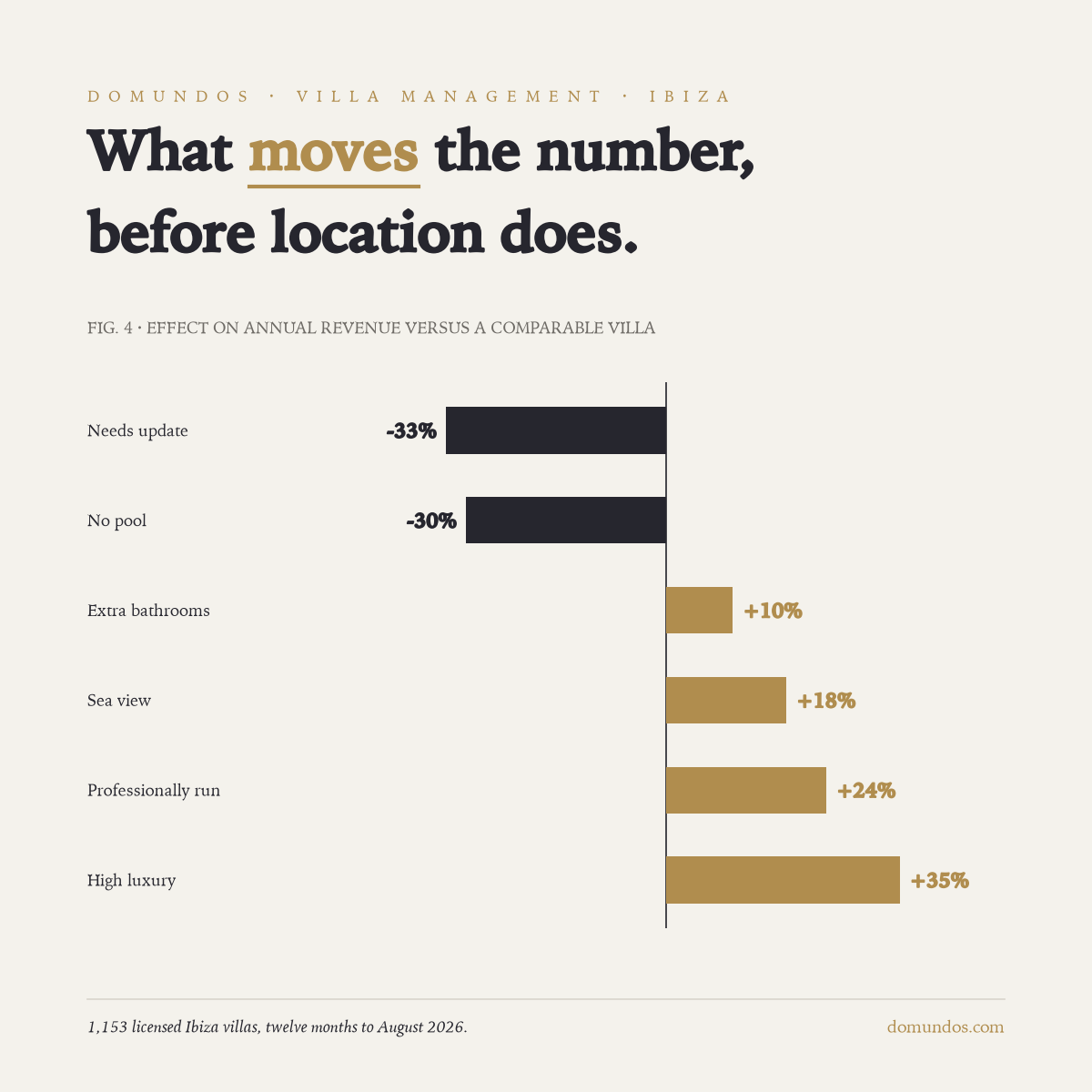
The professional-management effect in the data is larger than any single physical feature except a high-luxury finish: about 24% more revenue than a comparable villa without it, against 18% for a sea view and 10% per extra bathroom. That is the premium a good manager has to earn back before the fee is even discussed.
The Questions Worth Asking Before You Sign
Most owners approach the management selection process with questions about fees and marketing reach. Both matter, but they are downstream of more fundamental questions that determine whether the relationship will actually work.
Ask specifically how pricing decisions are made and who makes them. Is pricing set dynamically throughout the season based on demand signals, or is a rate card established at the start and largely left in place? Who has authority to adjust rates, and how frequently does that happen in practice? A management company that cannot answer this in operational detail probably does not have a genuine revenue management process.
Ask what happens when something goes wrong at 11pm on a Saturday in August. Not in general terms: specifically. Who answers the phone? What is their authority to act? Which contractor gets called, and how quickly can they reach the property? What does the owner communication look like in that scenario, and when does it happen? The answer to this question tells you more about a management company’s operational reality than any marketing material.
Ask how compliance is managed, not whether it is managed, but how. Who tracks certificate renewal dates? Who handles guest registration? Who monitors regulatory developments across the relevant municipalities? Who represents the property in the event of an inspection? A company with a genuine compliance process will answer these questions with specific names, systems, and procedures.
Ask what the exit process looks like. A management company confident in its service will be clear and fair about exit terms. One that builds in punitive exit clauses or makes transition deliberately difficult is signalling that it expects to retain clients through friction rather than performance.
Red Flags That Should Stop the Conversation
Some signals in the management selection process warrant immediate caution, regardless of how compelling other aspects of a company’s presentation may be.
Guaranteed income promises or fixed occupancy rate assurances should stop the conversation. Ibiza’s rental market is seasonal, demand-driven, and variable. No management company can guarantee specific income figures without either misrepresenting the market or subsidising the guarantee in ways that create problems elsewhere. These promises are either naive or dishonest. Neither is reassuring.
Vagueness about what the fee includes, and more importantly what it excludes, is a structural problem, not a negotiating position. A management company that cannot clearly articulate the scope of its service before signing a contract will not become clearer after it. Ambiguous fee structures almost always produce disputed invoices and deteriorating owner relationships.
Downplaying licensing requirements or suggesting informal approaches to compliance is the most serious red flag of all. In Ibiza’s current regulatory environment, any management company that characterises ETV licensing as optional, suggests that enforcement risk is manageable without full compliance, or implies that informal arrangements are standard practice is exposing you to financial and legal consequences that dwarf any other consideration in this conversation.
Reluctance to provide owner references, or providing only written testimonials without facilitating actual conversations, should prompt the question of why. In a relationship built on trust and transparency, a company with nothing to hide makes references easy.
Boutique vs Large Agency: Making the Comparison Honestly
The Ibiza management market contains every scale of operator, from individual managers handling a handful of properties to large international agencies with portfolios running into the hundreds. The choice between them is not simply about size. It is about what kind of attention your villa actually requires and which model is structurally capable of delivering it.
Large agencies offer genuine advantages. Brand recognition in source markets, established booking infrastructure, broad marketing reach, and the systems that come with processing significant booking volume. For owners whose primary concern is maximum distribution and who have a villa that fits a standardised service model, a large agency can deliver volume effectively.
What large agencies cannot structurally provide is intensive individual attention. When a portfolio runs to 150 or 200 properties, the management bandwidth per villa is mathematically constrained. Pricing decisions become templated rather than tailored. Maintenance issues compete for contractor access across a large client base. Owner reporting becomes standardised. The person managing your villa knows it as one of many rather than as a specific asset with specific characteristics.
Boutique local operators, companies that have made a deliberate choice to manage fewer properties more intensively, offer a different proposition. Faster decision-making, deeper property knowledge, stronger owner relationships, and the ability to respond to individual circumstances rather than process them through a standardised system. The trade-off is typically narrower marketing reach, which matters less than it once did given how much of the luxury villa booking journey now runs through direct channels, agencies, and referral networks rather than through the management company’s own booking platform.
The right choice depends on what your villa requires. A large, complex villa with high operational intensity and a non-resident owner who needs genuine visibility and responsiveness is typically better served by a boutique operator. A more straightforward property where maximum distribution is the primary concern may benefit from the scale a larger agency brings.
| Boutique Local Manager | Large International Agency | |
|---|---|---|
| Attention per property | High, deliberately limited portfolio | Lower, volume operation |
| Owner relationship | Direct and personal | Account management structure |
| Local knowledge depth | Deep, year-round | Variable, often seasonal |
| Response time | Fast, direct lines of accountability | Depends on coordination chain |
| Pricing approach | Tailored per property and week | Often templated across portfolio |
| Marketing reach | Focused, quality channels | Broad distribution |
| Compliance management | Integrated, actively monitored | Variable, depends on company |
| Best suited for | Premium villas, non-resident owners | Volume-focused, standardised assets |
How Domundos Approaches Villa Management in Ibiza
We are a boutique villa management company operating in Ibiza. We manage a deliberately small number of properties because that is the only way to deliver the level of attention that high-performing villas in this market actually require. We are on the island year-round, we know every property we manage in specific detail, and we treat compliance, pricing, maintenance, and guest experience as integrated components of a single operation rather than separate services that need to be coordinated between parties.
Our management fee ranges from 5% to 12% of gross rental income, structured around the specific services each property requires rather than the villa’s value or prestige. We are transparent about what sits inside that fee and what is billed separately as a direct pass-through cost. We provide structured owner reporting on a schedule, not on request. We have established contractor relationships across the island built through years of year-round engagement, which means our emergency response capability reflects actual infrastructure rather than a promise.
If you are evaluating management options for an Ibiza villa, whether you are in the process of buying, already own and are reconsidering your current arrangement, or are preparing a property for its first managed season, we are straightforward to talk to. We will tell you honestly whether your property is a good fit for what we do, and if it is not, we will say so.
You can find out more about how we work and what we manage, or consult the Balearic Government tourist rental regulatory framework for the regulatory context any management company should be navigating.