
A licensed four-bedroom villa in Ibiza earned a median €91,000 in the twelve months to August 2026. Against the €2 million to €2.5 million such a villa costs today, that is a gross yield of about 4% and, after running costs, closer to 3%. That single pair of numbers explains most of what follows: Ibiza is not a yield market, prices have run ahead of income, and the villas that beat the median do so through how they are run rather than where they sit. Below are the figures we work with every day, from 1,153 licensed villas.
What licensed villas actually earn
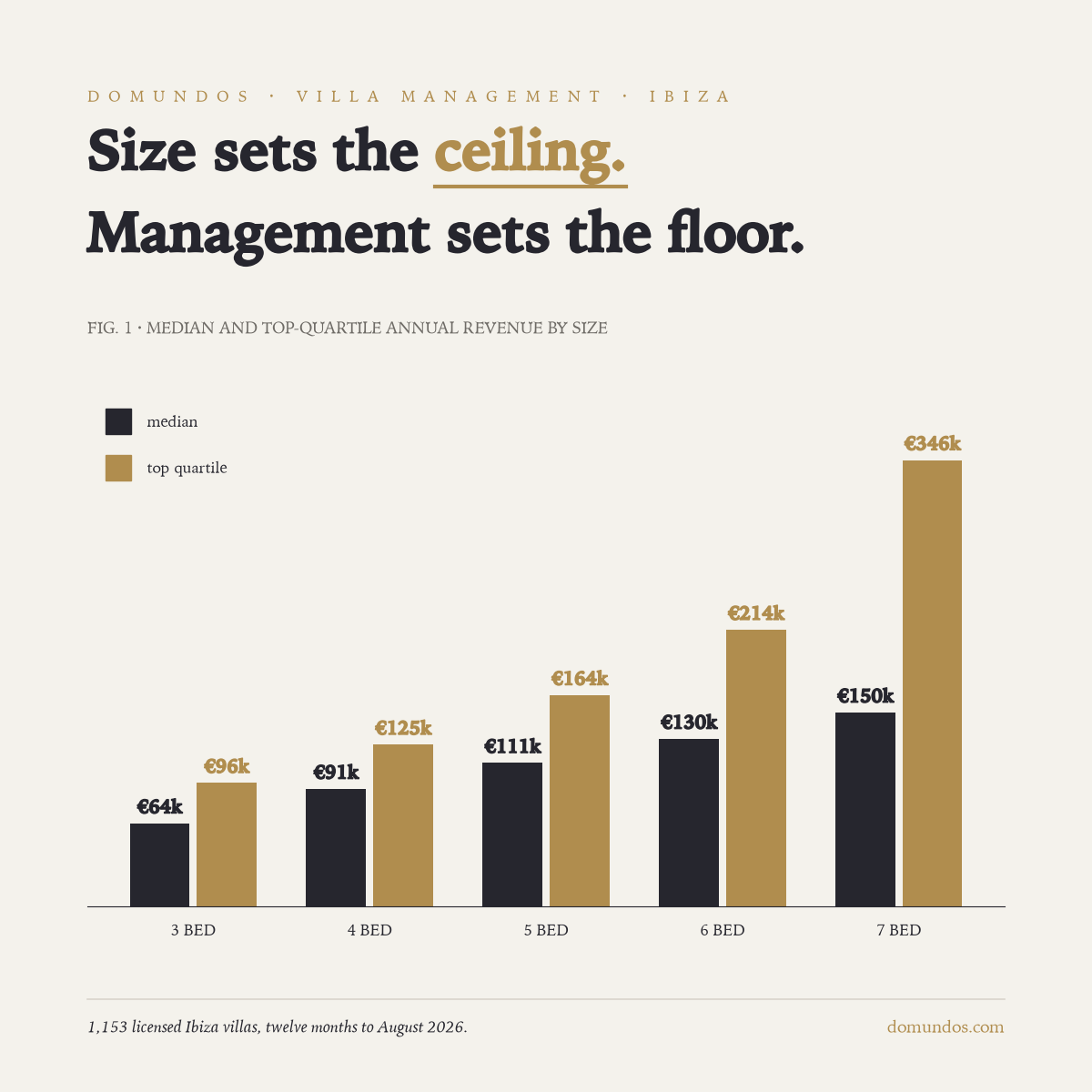
Income scales with size, but not in a straight line. The median three-bedroom licensed villa earned €64,000 in the year to August 2026; four bedrooms earned €91,000, five earned €111,000, six earned €130,000 and seven earned €150,000. Roughly €10,000 to €12,000 a year per licensed guest place is a fair rule of thumb across the range.
The top quartile is a different market. The best-run quarter of villas earned €96,000 at three bedrooms, €125,000 at four, €164,000 at five, €214,000 at six and €346,000 at seven. At the top of the size range the gap between a median villa and a top-quartile villa is more than double, and almost none of that gap is explained by location. It is explained by presentation, pricing discipline, reviews and the operation behind the calendar, which is why the same house can produce very different numbers under different management.
These are gross figures: what guests paid for the nights, before platform commissions, management fees and running costs. The income calculator applies the same dataset to your own villa, by municipality and size.
Where the income is
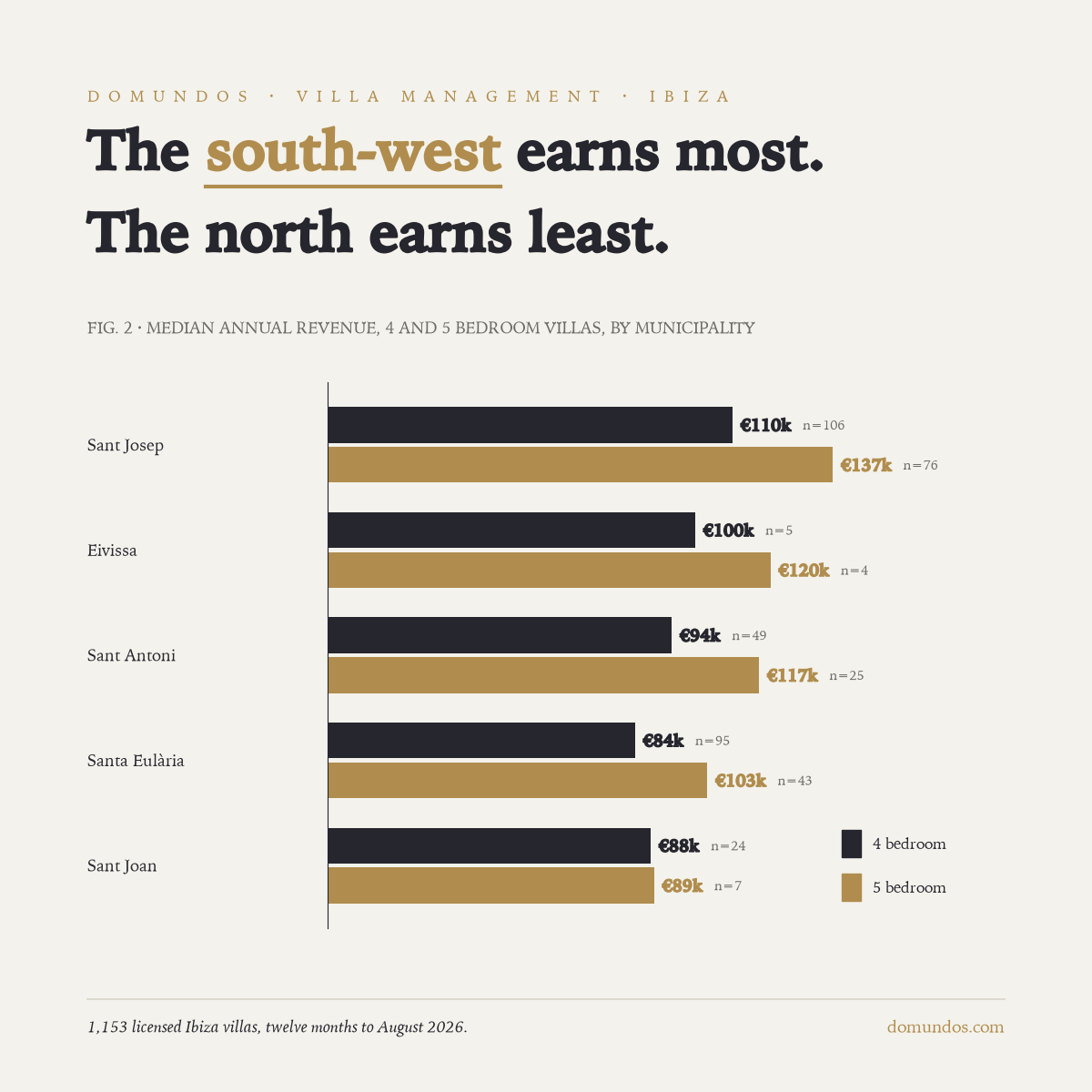
For a four-bedroom villa the medians by municipality are €110,000 in Sant Josep de sa Talaia, €100,000 in Eivissa, €94,000 in Sant Antoni de Portmany, €88,000 in Sant Joan de Labritja and €84,000 in Santa Eulària des Riu. At five bedrooms the spread widens: €137,000 in Sant Josep against €103,000 in Santa Eulària and €89,000 in Sant Joan. The south-west earns the most because it commands the highest peak-week rates: a five-bedroom villa in Sant Josep books at a median €1,315 a night in peak season, against €1,124 in Sant Antoni.
Two cautions. The Eivissa figures rest on a handful of villas (four to six per size), so treat them as indicative. And a higher median does not mean a higher yield, because purchase prices in the south-west have risen at least as fast as rates. Which areas suit which owners, and why some prestige addresses underperform their price tags, is the subject of Best areas and location.
Prices versus income: the yield reality
Headline transaction prices tell you what someone paid, not what the asset is worth as a rental business. Ibiza villa prices have risen sharply over the last few years, and licensed villas in established rental zones have risen most, because buyers now understand that a valid ETV licence is a finite asset: planning caps, zoning restrictions and active enforcement against unlicensed operators have made it scarce, and the market has priced that scarcity. Rental income has not kept pace. Peak rates in the luxury segment have grown, but more slowly than acquisition prices, and unevenly: mid-market villas have felt more pricing pressure than the top end.
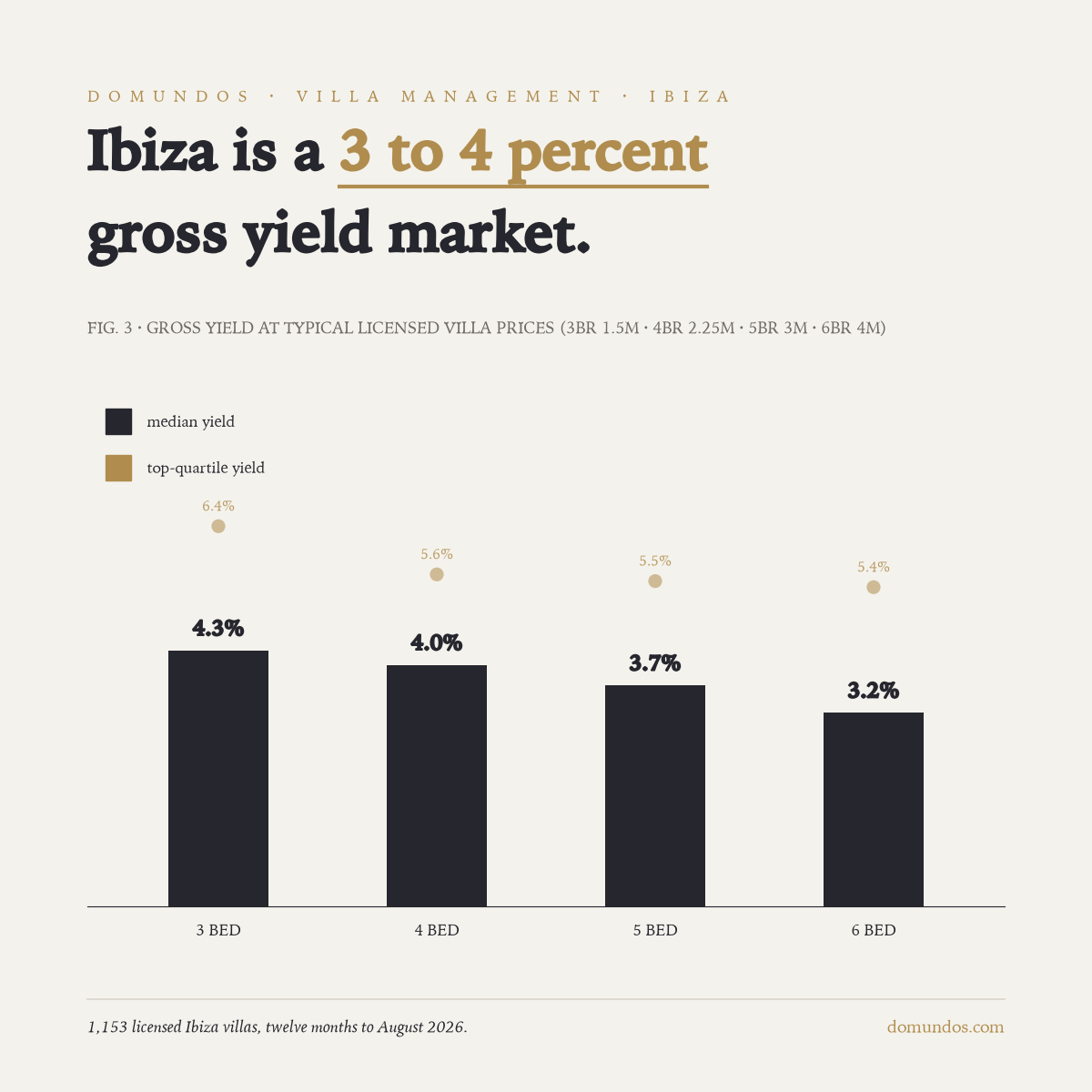
Put the two sides together and the yield picture is this (median revenue against a typical licensed purchase price; your own price will move the result):
| Villa | Median revenue | Top quartile | Typical price | Gross yield (median / top quartile) | Net yield at 30% costs |
|---|---|---|---|---|---|
| 3 bedrooms | €64,000 | €96,000 | €1.5M | 4.3% / 6.4% | 3.0% / 4.5% |
| 4 bedrooms | €91,000 | €125,000 | €2.25M | 4.0% / 5.6% | 2.8% / 3.9% |
| 5 bedrooms | €111,000 | €164,000 | €3.0M | 3.7% / 5.5% | 2.6% / 3.8% |
| 6 bedrooms | €130,000 | €214,000 | €4.0M | 3.2% / 5.4% | 2.3% / 3.7% |
Net is the number that matters, and the gap between gross and net in Ibiza is substantial. From the villas we run, total annual operating costs (management, cleaning and changeovers, maintenance, utilities, insurance, licence compliance and periodic reinvestment) consume 20% to 40% of gross income depending on size, service level and how remote the house is; the table uses 30%. What operating costs look like across a full year breaks the range down. A villa grossing €150,000 may net €90,000 to €120,000 before financing and tax. Against a €3 million purchase that is 3% to 4% in a well-managed case. That is not a yield investment. It is a lifestyle and capital-preservation asset that produces income as one part of its value, and the owners who are happiest bought it knowing that.
What moves the number, before location does
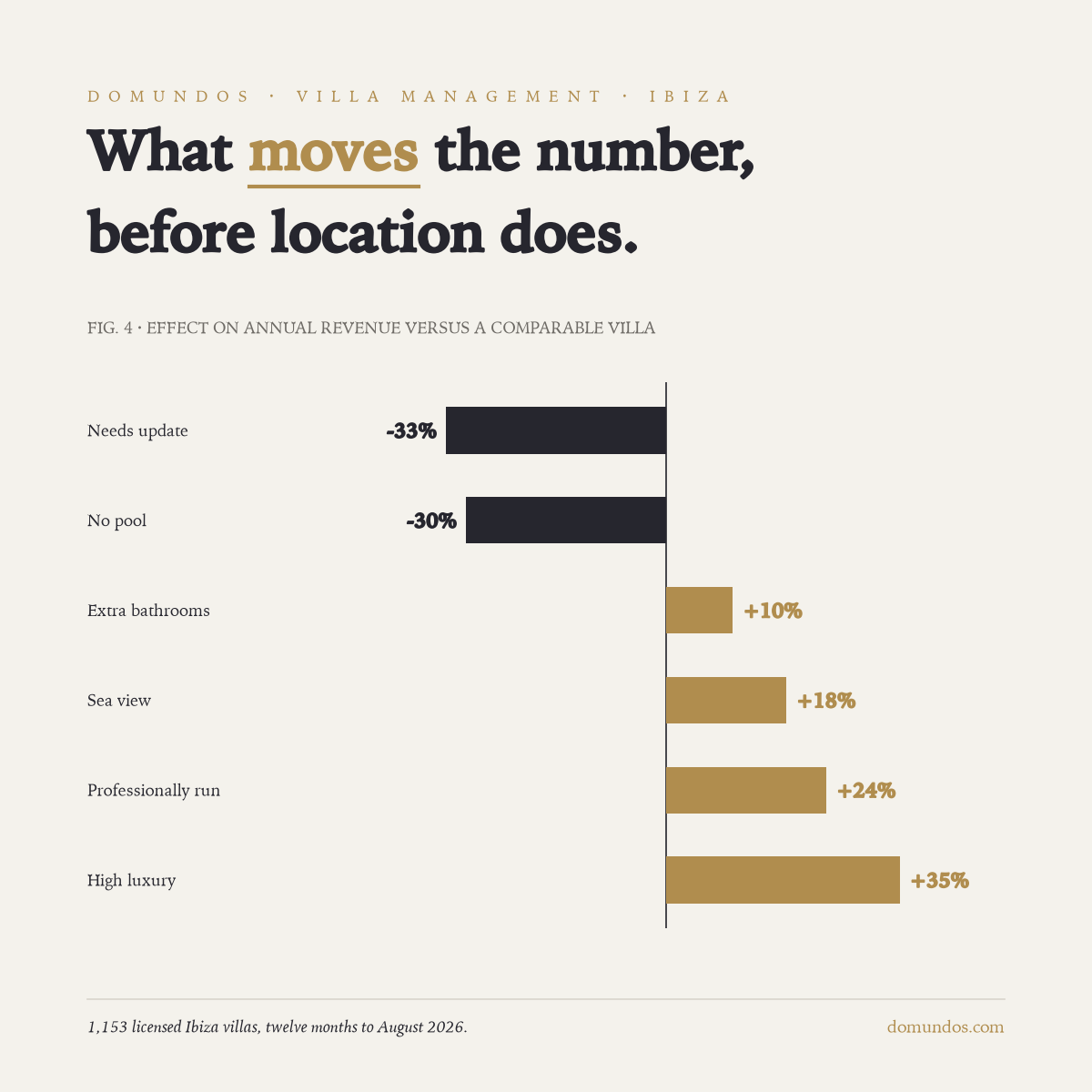
Across the dataset, five things move revenue more reliably than the postcode. A villa that needs updating earns about a third less than a comparable one in good condition; no pool costs about 30%; each bathroom beyond the norm for the size adds roughly 10%; a genuine sea view adds about 18%; a high-luxury finish adds about 35%. And villas run professionally, with the operation behind them that guests can feel in the reviews, earn about 24% more than comparable villas that are not. The buyer’s lesson is the same as the owner’s: the interior, the bathrooms and the operation are where money is made, and they are the parts you can change. What separates a well-managed villa from an average one is where that 24% comes from.
The licensed villa premium
The price gap between licensed and unlicensed villas has widened and keeps widening, and the premium is not for a piece of paper. An unlicensed villa that cannot obtain ETV status cannot legally earn short-term rental income at all, and fines for illegal letting run from €200,000 to €400,000 per property. The “discount” on such a villa reflects a structural limit that no price can fix. What a buyer must verify is not whether a licence exists but whether it is valid, transferable and unencumbered: structural changes, ownership changes, unresolved compliance issues or later zoning amendments can all compromise it. What an ETV licence involves and how it is obtained sets out the checks, and the Balearic tourism registry is where a licence is verified.
When the money is made
Across the dataset, 56% of the season’s revenue is already booked by the end of March, 82% by mid-May and 94% by mid-July. The peak weeks that owners imagine selling at a premium in August are, for a well-run villa, mostly gone by spring. This matches what we saw on our own calendars in 2026: early bookings held their rates, while last-minute gaps became much harder to fill than in previous seasons. For a buyer it means the income case rests on a villa that sells early, which is a marketing and pricing question, not a location question.
Long-term value: the argument that holds up
If the yield case has weakened, the long-term value case has strengthened for the same reasons. Supply is constrained in a way that will not change: planning limits, geography and a licensing framework that caps new tourist rental approvals in most zones mean the stock of legally rentable, well-located villas cannot grow to meet demand, and every enforcement action removes a competitor. Demand is global and resilient across Dutch, German, British, Swiss, French and Scandinavian markets, and the island’s position at the top end has strengthened as the experience has become more curated. The honest case for Ibiza is not “strong yields and quick appreciation”. It is a scarce, globally demanded asset in a supply-constrained market, which holds value and produces meaningful income when run well, with a lifestyle utility that a spreadsheet cannot capture. Whether that fits your objectives is the question to settle before the viewing trips start.
Sources and method
Revenue, rate, occupancy and feature figures: AirROI market data for 1,153 licence-linked Ibiza villas with three or more bedrooms, entire homes, twelve months to August 2026, compiled by Domundos; medians unless stated; municipality medians rest on 4 to 114 villas per cell. Operating cost range: Domundos managed portfolio. Fines: Balearic tourism law (Decret llei 3/2022) as applied by the Consell d’Eivissa. Purchase prices in the yield table are typical asking levels for licensed villas in 2026 and are assumptions, not data.