
The Wrong Question Most Owners Ask First
When owners start looking at villa management companies in Ibiza, the first question is almost always some version of: what do you charge? It is an understandable starting point. You are trying to control costs on an asset that already carries significant fixed overhead, and management fees are a visible, comparable line item. The problem is that fee percentage is one of the least useful metrics for evaluating management value in this market.
A company charging 8% of gross rental income and delivering disciplined pricing, full compliance management, proactive maintenance, and consistent guest experience will almost always produce a better net result for an owner than a company charging 5% and fragmenting responsibility, underpricing peak weeks, or creating compliance exposure that materialises as a €200,000 fine. The fee percentage tells you what management costs. It tells you almost nothing about what management delivers.
The correct question is not what does management cost, but what does good management return, and what does the absence of it cost. In Ibiza’s current market, where margins are tighter, enforcement is active, and one poor season can undo years of positioning, the answer to that second question is increasingly significant.
How Villa Management Fees Are Structured in Ibiza
Management fee structures across Ibiza fall into three broad models, each with different incentive dynamics and risk profiles for owners:
Percentage-based commission is the most common structure in the luxury villa segment. The management company takes a percentage of gross rental income, typically somewhere between 3% and 20% depending on the scope of services and the company involved. This model aligns the manager’s financial interest with the owner’s: when income increases, both benefit. When bookings are weak, the manager also feels it. For non-resident owners who want genuine performance alignment, this structure makes logical sense.
Fixed monthly retainer charges a set fee regardless of rental income. This can appear predictable and budget-friendly, but it fundamentally misaligns incentives. In a strong season, the manager captures the same fee whether the villa performs at 60% or 95% occupancy. In a weak season, the owner pays the same regardless of income. Fixed fee models work best for owners who use their villa primarily for personal use with limited rental activity, not for owners whose primary objective is optimising rental performance.
Hybrid models combine a base retainer with a performance commission. These can work well when structured correctly: the retainer covers genuine fixed operational costs, and the commission preserves performance alignment on the income side. The risk is that poorly constructed hybrids simply layer costs without providing meaningful alignment.
| Commission-Based | Fixed Monthly | Hybrid | |
|---|---|---|---|
| Fee alignment with performance | Strong | None | Partial |
| Owner cost in weak season | Lower, scales with income | Fixed regardless | Partially fixed |
| Manager incentive to maximise | High | Low | Moderate |
| Predictability for owner | Lower | High | Moderate |
| Best suited for | Rental-focused owners | Personal use, limited rental | Varies by structure |
What Is and Is Not Included: The Question That Matters Most
The headline management fee percentage means nothing without understanding what sits inside it and what sits outside it. This is where fee comparisons break down completely, and where apparently cheaper management arrangements reveal themselves to be more expensive in practice.
Full-service management at the higher end of the fee range typically includes pricing strategy and dynamic rate management, multi-channel marketing and listing management, guest enquiry handling and booking confirmation, guest communication throughout the stay, check-in and check-out coordination, cleaning supervision and quality control, maintenance oversight and contractor coordination, regulatory compliance monitoring, license and certificate management, and financial reporting to the owner. That is a comprehensive scope of responsibility concentrated under one accountable party.
Partial management at a lower fee rate typically includes some subset of the above, often marketing and booking management, while leaving cleaning coordination, maintenance oversight, compliance management, and guest support either to the owner or to separately engaged providers. The headline fee looks lower. The total cost of assembling the full operation from fragmented providers rarely is.
The specific questions every owner should ask before signing a management contract are these: Is dynamic pricing in place, or is pricing set statically at the start of the season? Who coordinates cleaning and confirms standards after each turnover? Who handles maintenance calls and contractor access? Who monitors compliance and manages certificate renewals? Who is the guest’s point of contact at 10pm on a Saturday? If the answer to any of these is “the owner” or “a third party not covered by this agreement,” the fee comparison is not comparing equivalent services.
The Hidden Costs That Erode Net Income
Beyond the management fee itself, a range of operational costs sit underneath the headline that owners regularly underestimate when projecting net income. These are not hidden in the sense of being concealed. They are simply not front of mind at the point of engagement, and they add up to a material share of gross rental income across a full season.
Cleaning and linen services are typically charged separately from management fees and scale directly with occupancy. A high-turnover villa with back-to-back Saturday changeovers through July and August will incur cleaning costs that owners in their first season regularly find surprising. Professional cleaning teams in Ibiza charge around €20 to €25 per hour in high season, and a thorough luxury-standard turnover on a larger villa is not a two-hour job.
Maintenance costs, routine, preventative, and emergency, represent another significant variable. Pool and garden servicing, air conditioning maintenance, irrigation system upkeep, and the inevitable emergency repairs that peak season produces all sit outside most management fee structures. Owners who budget conservatively for maintenance spend less time being surprised by invoices and more time understanding their actual net position.
Utilities during occupied periods, electricity, water, and gas, spike significantly during peak summer months. Air conditioning running continuously across multiple zones, pools heated and filtered, and the general consumption of a full household of guests over multiple weeks adds up to costs that can catch owners off guard if they have only experienced the property’s off-season baseline.
Other costs that compound quietly include consumables replenished between guests, periodic replacement of worn soft furnishings, compliance-related administrative costs, and the cost of owner-requested modifications or upgrades during the season. None of these is individually enormous. Together, across a full season, they represent the difference between a gross income figure and a net one that is meaningfully smaller.
The true annual cost of owning an Ibiza villa
Management is one line in a longer list, and the list runs whether or not the villa is let. From the villas we run, total annual operating costs, including management, cleaning and changeovers, pool and garden, maintenance and reserves, utilities, insurance, local taxes and compliance, come to 20% to 40% of gross rental income for a villa that is let well. For a median four-bedroom villa earning €91,000 a year that is €18,000 to €36,000, and a large part of it (pool, garden, insurance, IBI, standing utilities and a maintenance reserve) is fixed: it falls due in a year with no bookings at all.
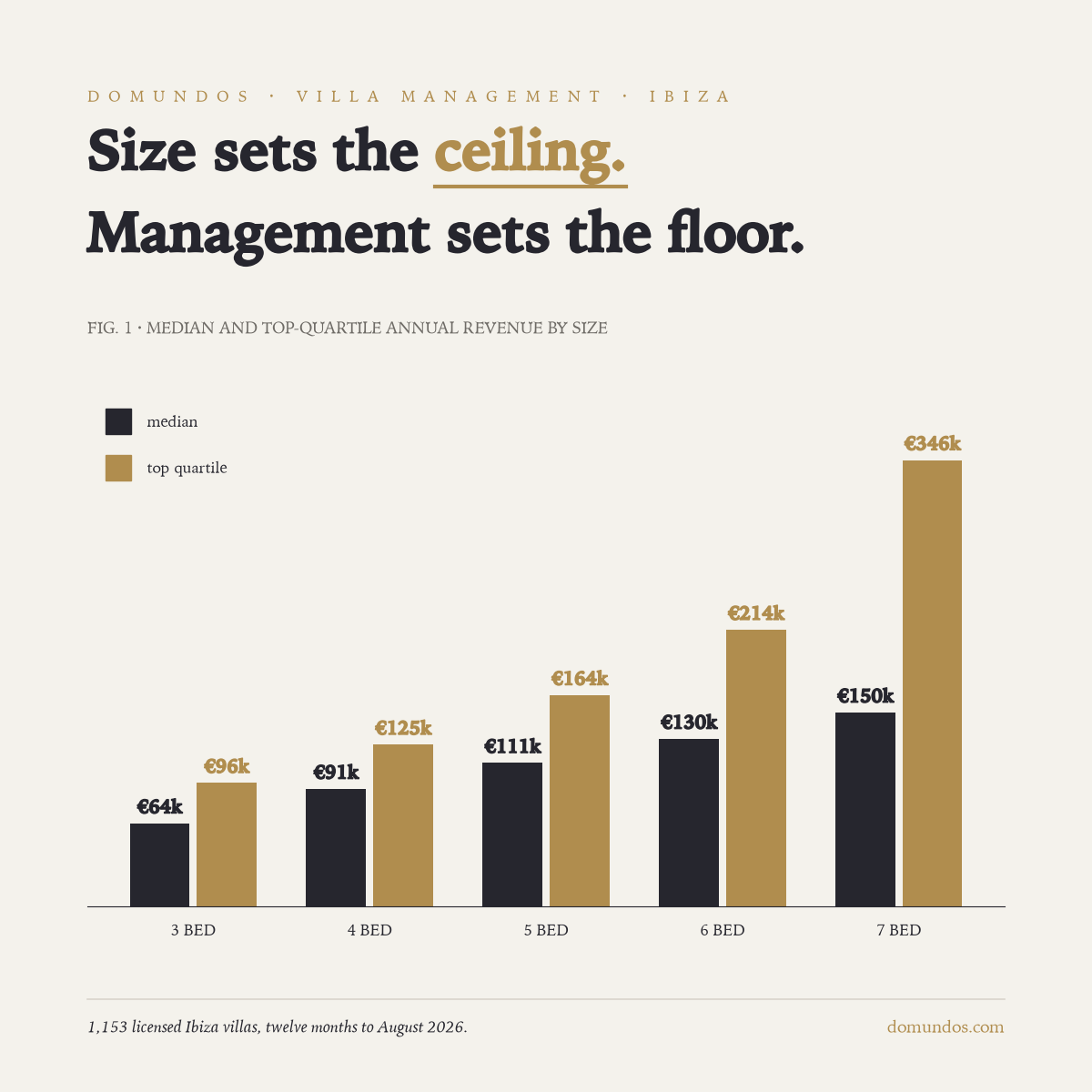
Two consequences follow. First, the fee percentage matters less than the gross it is applied to: a manager who lifts a €91,000 villa to the top quartile at €125,000 has paid for the fee several times over. Second, an owner who plans to let lightly, or not at all in some years, should budget the fixed costs as a cost of ownership, not of letting. The gross-to-net arithmetic by villa size, with net yields at 2026 purchase prices, is in Ibiza villa rental income and ROI.
What Domundos Charges and What That Covers
We are transparent about our pricing because we think transparency is both commercially honest and practically useful for owners trying to make informed decisions. Our management fees are always structured around the specific services we provide for a specific property, not around the value or prestige of the villa itself. A large villa requiring more operational intensity pays more than a compact villa requiring less, because the cost of doing the job properly is different, not because one property is more impressive than the other.
Our services typically range from 5% to 12% of gross rental income, depending on the scope of management required. That range reflects genuine variation in what different villas and different owner situations demand: it is not a negotiating position or a teaser rate that expands once the contract is signed.
What sits inside that fee: pricing strategy and dynamic revenue management, marketing and multi-channel distribution, full guest communication from enquiry through check-out, cleaning coordination and quality oversight, maintenance management and contractor relationships, compliance monitoring and regulatory administration, and financial reporting to the owner on a structured schedule. What sits outside it, and is billed transparently as it occurs, is the direct cost of cleaning services, maintenance work, and consumables. These are pass-through costs that we coordinate but do not mark up beyond a coordination margin that is disclosed in our agreements.
We manage a deliberately small number of properties because that is what makes this level of service possible. An operation managing 150 villas cannot provide the individual attention that this fee structure implies. We chose the model that produces better results per property rather than the model that produces greater volume.
If you would like to speak to us about managing your Ibiza villa, we are happy to have a direct conversation about what the fee structure would look like for your specific property.
The Real Cost of Getting Management Wrong
The final cost consideration that owners rarely factor into their management decision is the cost of poor management, not as a fee, but as a consequence. This is the hardest number to put on a spreadsheet because it is hypothetical until it happens, but in Ibiza’s current market it is increasingly real and increasingly quantifiable.
Poor pricing in peak weeks, undercharging because dynamic management is not in place, or leaving weeks unfilled because the booking window was mismanaged, costs owners income that cannot be recovered. One mispriced August week at a premium villa is not a rounding error. It is a five-figure loss that no management fee saving compensates for.
Compliance failures cost more still. A property managed without proper attention to licensing, guest registration, or certificate maintenance is a property with unquantified legal exposure. In Ibiza’s current enforcement environment, that exposure has a realistic downside measured in hundreds of thousands of euros. No management fee saving is worth that risk.
Reputational damage from poor guest experience, slow responses, substandard cleaning, maintenance failures that are handled badly, compounds across seasons in a way that is genuinely difficult to reverse. A villa that builds two or three years of weak reviews faces a repositioning challenge that requires significant time and investment to overcome. The cost of preventing that damage through good management is a fraction of the cost of repairing it.
Good management in Ibiza is not a cost to minimise. It is the mechanism by which a villa’s potential is either captured or left on the table. The owners who understand that consistently outperform those who do not.
Owners assessing the full cost of ownership including tax obligations can consult the Spanish tax authority guidance for villa owners.