
Ibiza Villa Ownership: The Big Picture
If you take one thing from this guide, take this: in 2026 a licensed Ibiza villa is a 3% to 4% gross yield asset that only performs when it is run like a small hotel, and the rules around it are enforced. The median four-bedroom villa earned €91,000 last year, the best quarter €125,000, and the gap between the two was operations, not location. Start here, then read the chapters in order.
Let me be direct with you. Most people who look at owning a villa in Ibiza are still operating on a mental model from 2015. Buy something with a pool and a sea view, throw it on Airbnb in June, collect the money. That model is gone. Not dead, gone. The island still rewards owners who approach it correctly. But the gap between “approached it correctly” and “assumed it would work out” has never been wider.
I’ve been operating in Ibiza for years, and what I see repeatedly is buyers arriving with information that’s anywhere from two to five years out of date. Property values have climbed sharply, faster than rental income. Regulation has shifted from background noise to front-page enforcement. And the owners who are genuinely extracting value from their villas are the ones who treated this like a serious business from day one, not a lifestyle purchase with a yield attached.
At Domundos, we manage a deliberately small number of properties. That’s a strategy, not a limitation. When you manage 150 villas across an island, your attention per property is mathematically divided. We’ve seen what that produces: missed maintenance, reactive compliance, and owners who feel like a reference number rather than a partner. We chose a different path. Fewer villas, deeper involvement, better results per property. It’s a different model, and it produces different outcomes.
Why the Ibiza Rental Market Is Harder Than It Looks Right Now
Here’s the uncomfortable truth that most villa agents and property promoters will not tell you: purchase prices in Ibiza have outpaced rental income. Not slightly, meaningfully. A villa that looked like a reasonable income-producing asset two or three years ago would require near-perfect management today to justify the current acquisition price on rental income alone. That’s the market you’re buying into.
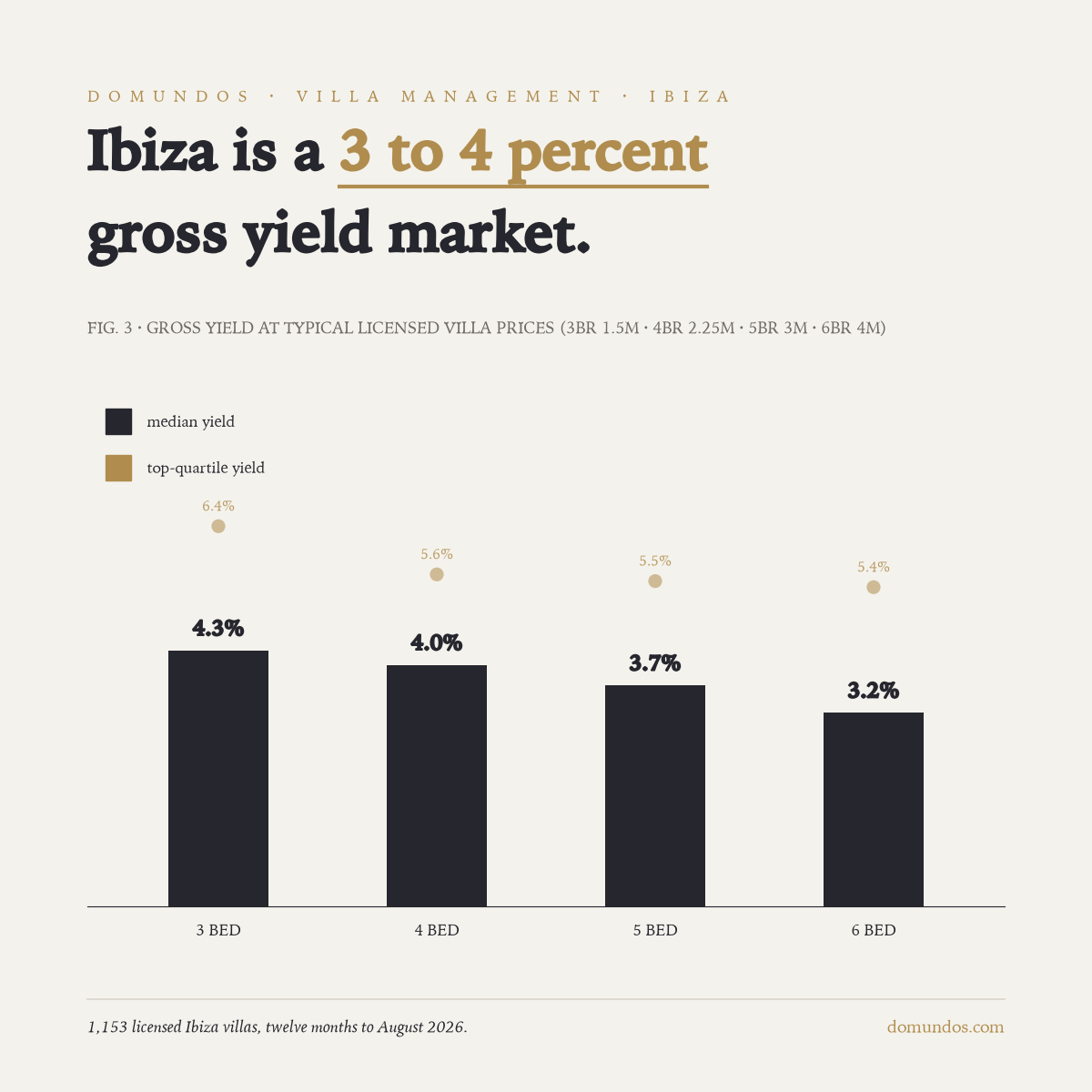
The numbers behind that sentence: a median four-bedroom licensed villa earned €91,000 in the twelve months to August 2026, which at today’s €2 million to €2.5 million purchase prices is a gross yield of about 4% and a net yield nearer 3% once running costs are paid. The full breakdown by size and municipality is in Ibiza villa prices and yields.
Seasonality hasn’t improved either. The majority of revenue is still compressed into a short peak window, while costs, including staffing, maintenance, utilities, insurance, compliance, and management fees, run twelve months a year. If you miss one peak summer due to poor pricing, operational failure, or a bad start with a new management company, you don’t get that back. There’s no Q4 recovery in Ibiza villa rentals.
The regulatory environment has shifted dramatically. Inspections are more frequent, platforms cooperate with authorities, and fines have moved from symbolic to genuinely damaging. Local newspapers report penalties regularly, from €200,000 to over €400,000 for single unlicensed properties, with some enforcement campaigns issuing multi-million euro sanctions in a single sweep, as reported by Periódico de Ibiza
What hasn’t kept pace with all of this? Net income. Gross rental figures can look impressive on a spreadsheet while actual returns quietly disappoint once costs, taxes, and compliance overhead are stripped out. The owners who are performing well right now aren’t the ones with the biggest villas or the most prominent locations. They’re the ones with the tightest operations.
Why Ibiza Remains One of Europe’s Top Luxury Rental Markets
None of the above means Ibiza doesn’t work. It means it requires more precision than it used to. The underlying demand story is still strong, and in key ways it’s structurally protected. Here’s what keeps Ibiza near the top of any serious analysis of European luxury rental markets:
- A dense ecosystem of Michelin-listed restaurants, celebrity chefs, and curated hospitality experiences that guests genuinely cannot replicate elsewhere
- A global nightlife brand that continues to attract premium spending visitors, including people who want to be adjacent to that energy with privacy intact, not just the clubbing crowd
- Short travel distances that let guests move between beach clubs, marinas, and towns without the logistical friction of larger destinations
- Planning laws and licensing caps that constrain supply, protecting long-term asset values for compliant owners
- A repeat-guest culture in the luxury villa segment that no other Mediterranean destination quite matches, and when Ibiza guests love a villa, they come back
The planning constraint is worth dwelling on. Ibiza cannot simply build more licensed villas to meet demand. The licensing framework makes that structurally impossible in most zones. That limits supply in a way that insulates well-positioned, fully compliant owners from competition. It also explains why licensed villas trade at a significant premium, and why buying without clear license eligibility is one of the most expensive mistakes you can make.
Who This Guide Is Written For
This guide is written for people who are past the brochure stage. If you already own a villa in Ibiza and want to professionalise what you’re doing, it’s for you. If you’re evaluating whether to buy and want an honest analysis rather than a sales pitch, it’s for you. If you’ve already bought and things aren’t performing the way they should, it’s especially for you.
It’s also written specifically for non-resident owners: the Dutch, German, British, and Swiss buyers who dominate the villa market here and manage their assets from abroad. Ibiza can absolutely be run remotely. Most serious owners do exactly that. But it only works when supported by management that treats your property with the same attention it would receive if you lived five minutes away. That’s what we do. That’s the operational reality of what keeps a villa performing through a season when you’re not on the island, not marketing.
The guide runs in seven chapters: whether it is worth it, what to buy, the rules, how the villa is run, keeping it in shape, filling it, and the monthly market numbers. The table of contents lists every article.
Short-term or long-term? The short version
This comes up in almost every owner conversation. For a licensed villa, holiday letting earns more (a median €91,000 gross a year at four bedrooms against €48,000 to €72,000 from a long-term tenancy) but costs far more to run and carries the compliance load; for a median villa the net gap is smaller than owners expect, and only the best-run quarter of holiday villas pulls clearly ahead. Unlicensed villas have no choice. The full comparison, including the hybrid model, is the next article in this chapter.
Can You Actually Run a Villa Remotely?
Yes. Most of our owners do exactly that. But I want to be precise about what “remote ownership that works” looks like versus the version that quietly falls apart.
Remote ownership that works has a local management team handling every element of operations: pricing, guest communication, cleaning coordination, maintenance response, compliance monitoring, and financial reporting. The owner sees detailed reporting, makes strategic decisions, and visits when they want to. They are not out of the loop. They’re just not physically present.
Remote ownership that doesn’t work is when an owner is abroad, nominally using a management company, but with unclear accountability, no structured reporting, and no real visibility into what’s happening on the ground. We see this regularly. The villa looks managed on paper; in practice, reviews are declining, maintenance is reactive, and compliance is an afterthought.
The difference between those two scenarios is not technology, and it’s not luck. It’s the quality of local management and the structure behind it. That’s the only thing that actually determines whether remote ownership performs.
Non-resident owners should also read the Spanish tax authority guidance for non-residents before the first season.