
The Question Every Ibiza Owner Gets Wrong
The short answer for a licensed villa: short-term letting earns more, but by less than owners assume once costs are in. A median four-bedroom villa earned €91,000 gross from holiday lets in the year to August 2026; the same villa let long-term at the €4,000 to €6,000 a month we see asked in 2026 brings €48,000 to €72,000. After the far higher running costs of holiday letting, the net gap narrows to a few thousand euro for a median villa and only opens up again for the best-run quarter. Unlicensed villas do not have the choice at all. Here is how to decide, in the right order.
Most owners frame this as a financial question. Short-term versus long-term, which one pays more? I understand why. You’ve spent a significant amount of money on a property, you want it to work, and “yield” feels like the right metric to optimise for. But in 2026, framing it purely as a yield calculation is how owners end up disappointed, overexposed, or legally compromised within twelve months of entering the market.
The correct framing, the one that actually leads to good decisions, is: which rental model fits your legal situation, your operational capacity, your personal use plans, and your long-term objective for this asset? That question is harder to answer, but it’s the one that matters. The yield follows from getting those fundamentals right. Chasing yield first, on the wrong property, with the wrong structure, is the most reliable way to underperform in Ibiza.
At Domundos, we work with owners on both sides of this decision. And what we’ve learned, managing intensively on the island rather than across a sprawling portfolio, is that the right answer depends on specifics, not on a general rule that someone read in a property forum three years ago.
What Short-Term Rental Actually Means in Ibiza
Short-term rental in Ibiza means operating under a tourist rental license, the ETV, and renting your villa by the week or night to holiday guests during the season. It is a commercial activity, governed by the Balearic Government, subject to inspection, and increasingly enforced with significant financial penalties for those operating without proper compliance.
Let’s be honest about what this model looks like in practice. The revenue opportunity is real. Prime luxury villas during peak summer weeks command rates that few other European destinations can match. A well-positioned, well-managed, fully licensed villa in the right location can generate the majority of its annual income across eight to ten peak weeks between late June and early September. That concentration is both the model’s greatest strength and its most significant structural risk.
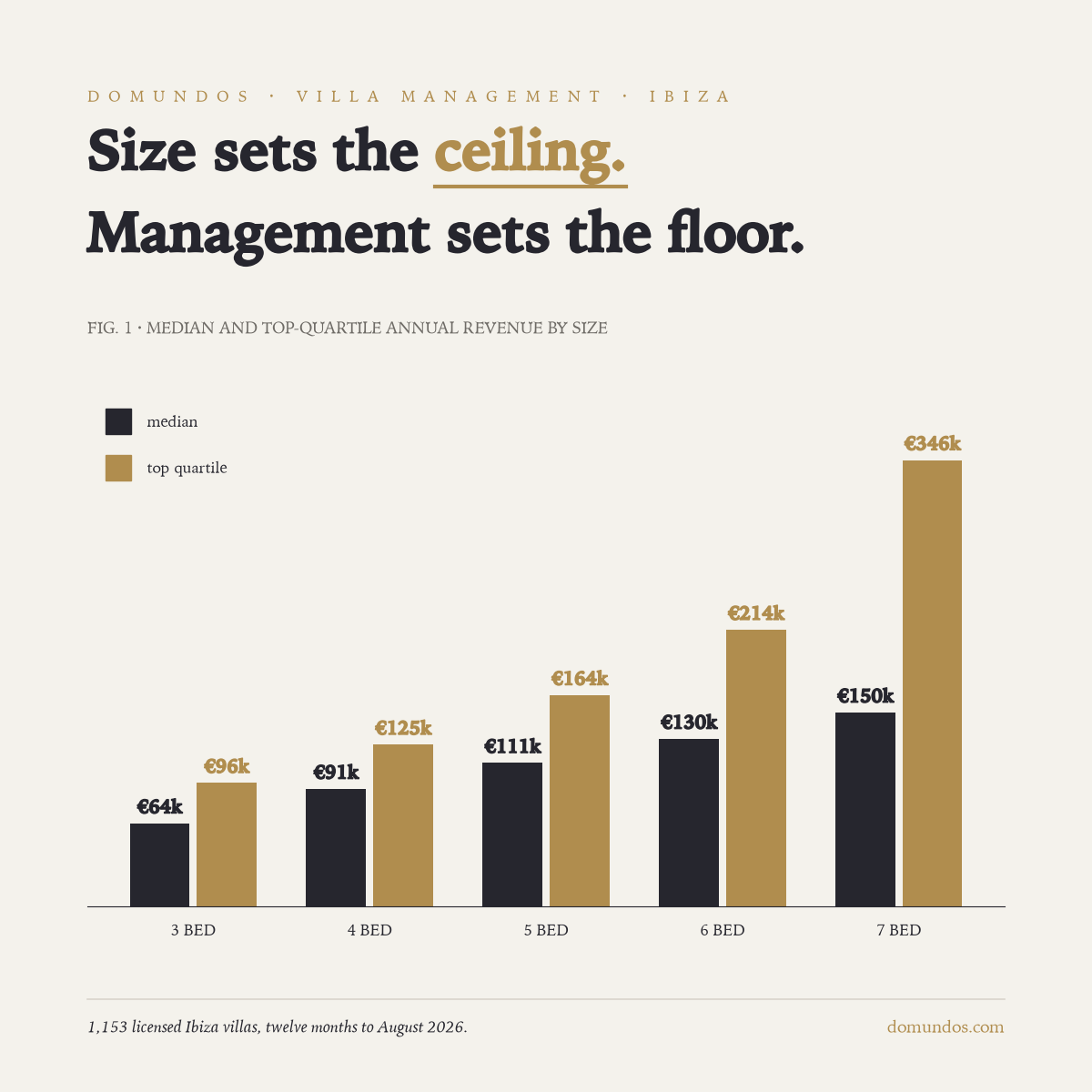
In numbers: the median licensed villa earned €64,000 a year at three bedrooms, €91,000 at four, €111,000 at five and €130,000 at six in the twelve months to August 2026; the top quartile earned €96,000, €125,000, €164,000 and €214,000. Those are gross figures before platform commissions, management and running costs, which take 20% to 40%.
The operational weight is substantial. Short-term renting in Ibiza requires a valid ETV license, a habitability certificate, an energy efficiency certificate, guest registration with the police, correct waste management procedures, and compliance with capacity and safety standards. On top of that, cleaning turnovers at luxury standard, dynamic pricing management, guest communication, maintenance response, and review management must all run consistently across a compressed season.
This is not a passive income model. Owners who treat it as one, or who hire management that treats it as one, consistently underperform. The villas that generate strong short-term income are operated with the same discipline as a small hotel, just without the front desk.
What Long-Term Rental Actually Delivers in Ibiza
Long-term rental, typically defined as rentals exceeding one month, often running for six to eleven months, is the structurally simpler option. No ETV license is required. Operational complexity is dramatically lower. You have a tenant, a contract, and a predictable income stream without the week-to-week intensity of short-term management.
Here is the honest assessment, with numbers. A four-bedroom villa that would fetch a median €91,000 gross from holiday lets is asked at €4,000 to €6,000 a month long-term in 2026, or €48,000 to €72,000 a year. The long-term figure carries far lower costs (no changeovers, no platform commission, no seasonal staffing, typically 10% to 15% of rent for maintenance, insurance and administration), so net income is roughly €42,000 to €63,000 against about €64,000 net for the median holiday-let villa. For a median villa the two models are closer than most owners believe. What long-term letting cannot do is reach the top quartile: the best-run holiday villas net €85,000 to €90,000 at four bedrooms, and no tenancy gets there. Against a €2 million to €2.5 million purchase, long-term letting is a gross yield of roughly 2% to 3.5%; that is the arithmetic behind the sentence that follows.
That said, long-term rental is not without merit. It works well for owners who need operational simplicity, who cannot or do not want to engage with the ETV licensing process, or who are in a holding pattern while a property undergoes renovation or repositioning. It also works well for owners whose primary motivation is not yield but asset preservation: keeping a villa occupied, maintained, and generating some income while they decide on a longer-term strategy.
What long-term rental does not solve is the fundamental economics of owning a premium Ibiza villa at current prices. If the acquisition was made primarily on income expectations, long-term rental is unlikely to deliver satisfaction. That is a realistic read of the numbers, not a criticism of the model.
Side-by-Side: Short-Term vs Long-Term in Ibiza
Here is a direct comparison of how both models actually perform across the factors that matter most to owners in today’s market:
| Short-Term Rental | Long-Term Rental | |
|---|---|---|
| License required | Yes, ETV mandatory | No license required |
| Typical gross income, 4-bedroom villa | €91,000 median, €125,000 top quartile | €48,000 to €72,000 |
| Income potential | High, heavily seasonal | Moderate, predictable |
| Operational complexity | High | Low |
| Regulatory risk | High without full compliance | Minimal |
| Owner flexibility for personal use | High, structure around bookings | Low, tied to tenancy agreement |
| Gross yield potential (current prices) | Higher ceiling, narrower window | Lower ceiling, more stable floor |
| Management intensity | Professional management essential | Lighter management touch sufficient |
| Exposure to enforcement | Direct and significant | Minimal |
| Guest wear and tear | High, multiple turnovers per season | Lower, single occupant |
| Best suited for | Licensed villas, professional operations | Unlicensed properties, owners in transition |
The table above reflects what we actually see on the ground, not what a yield brochure will tell you. The short-term model offers a higher ceiling but demands proportionally more in structure, compliance, and execution. The long-term model offers stability but often disappoints owners who entered the market expecting premium income.
Hybrid Strategies: When It Makes Sense to Combine Both
A small number of owners operate a hybrid approach: renting short-term during peak summer months and transitioning to a medium or long-term tenant during winter. Done correctly, this can provide a meaningful income floor through quieter months while still capturing the premium of peak-season short-term rates.
The practical challenges are real. Transitioning between rental modes requires careful contract management, tenant selection, and a property handover process that protects the villa’s condition. Short-term guests in July and August place heavy usage demands on a property. A long-term tenant arriving in October needs a villa that is in good condition, fully functional, and clearly documented.
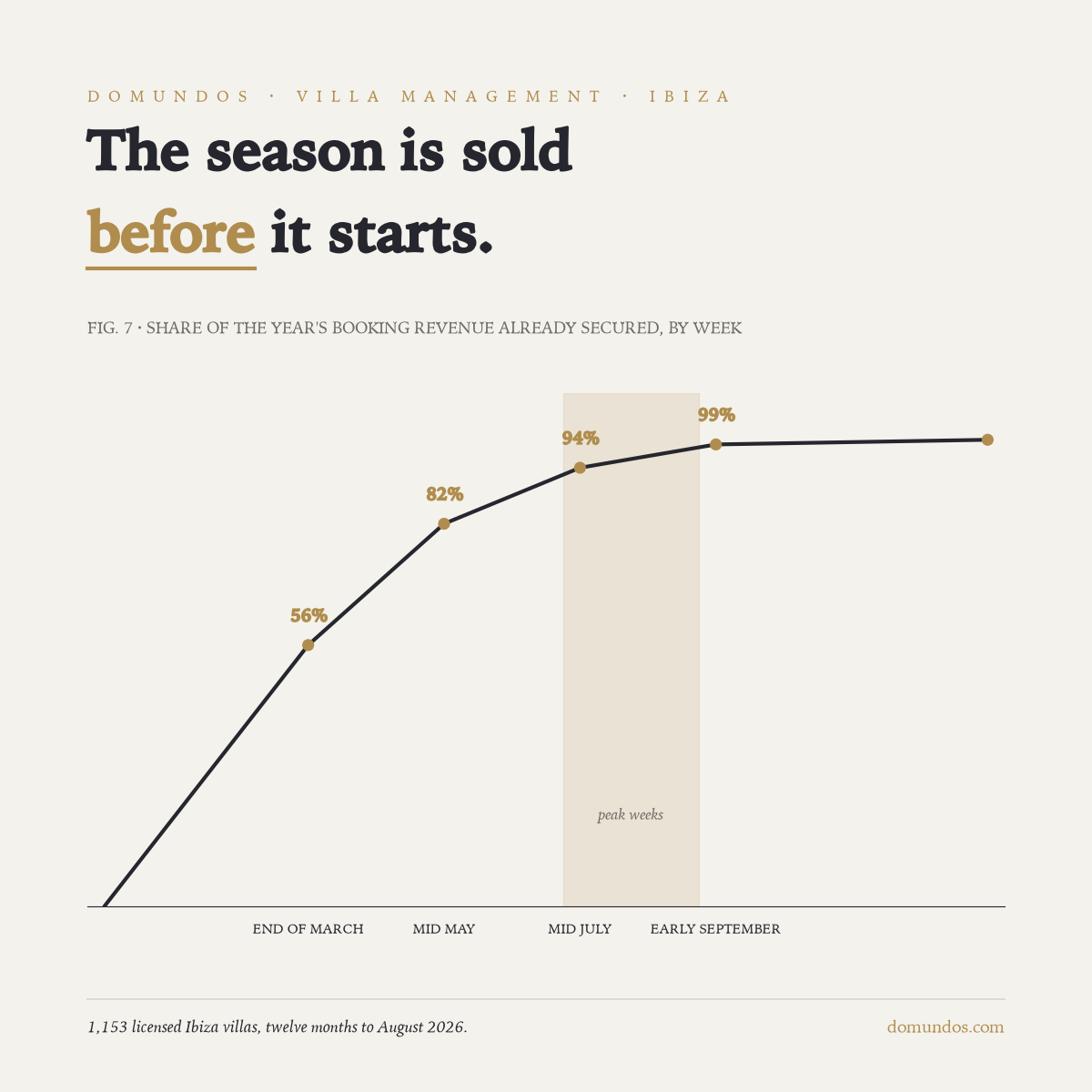
Timing decides whether a hybrid works. Across the dataset 56% of the year’s holiday-let revenue is booked by the end of March and 94% by mid-July, so a winter tenancy that starts in October has to be arranged before the summer, not after it, and the villa has to be returned to letting condition in spring on a fixed date.
This model also requires your ETV license to be fully in order. You cannot operate short-term during summer and then shift to long-term to avoid compliance. Regulatory authorities are aware of this pattern, and blended usage without proper structure creates exposure rather than eliminating it. If a hybrid approach is relevant to your situation, it needs to be designed deliberately, with proper legal and management advice in place before the season begins and the Spanish tax treatment of blended rental income understood in advance.
How to Actually Decide Which Model Is Right for You
The decision between short-term and long-term rental in Ibiza is not primarily a financial one, although it has major financial consequences. It is a legal, operational, and personal decision that happens to affect your income. Getting the sequence right matters.
Start with legality. Does your property hold a valid ETV license, or is it clearly eligible for one? If the answer is no or unclear, short-term rental is not a viable option regardless of how attractive the income projections look. Operating without a license is not a calculated risk anymore: the fines are large enough and enforcement frequent enough that it is simply irrational.
If you are licensed, or licensing is achievable, the next question is operational. Are you prepared to manage a short-term rental properly, either personally or through a professional management company that takes full responsibility for operations, compliance, and reporting? Half-measures produce poor reviews, legal exposure, and declining income. If the honest answer is that you want something hands-off and low-maintenance, short-term renting in Ibiza is probably the wrong model regardless of the yield numbers.
Finally, be honest about your personal use. Short-term renting gives you flexibility: you can block off weeks for yourself, adjust the calendar around your schedule, and still participate in peak season income. Long-term renting removes that flexibility almost entirely. If you bought an Ibiza villa partly because you want to use it, locking it into an annual tenancy agreement significantly changes the nature of ownership.
In our experience at Domundos, the owners who are most satisfied are not necessarily those generating the highest gross income. They are the ones who entered with a clear model, chose the right management structure for that model, and understood from the beginning what they were actually building: a controlled, professionally run asset rather than a passive income stream that manages itself.