
Marketing Is Not a Channel Strategy. It Is a Positioning Decision.
Most villa owners approach marketing as a distribution problem. Which platforms should I be on? Should I use an agency or list directly? Do I need Instagram? These are legitimate operational questions, but they are the wrong starting point. The starting point is positioning: what your villa is, who it is genuinely for, and why a guest should choose it over the fifty other comparable properties they are looking at in the same week.
In a market where supply of licensed, well-located villas has grown and guest expectations have been shaped by global luxury benchmarks, undifferentiated presentation is commercially expensive. A villa that looks like every other villa in the same category, priced similarly, with similar photography and similar copy, is making a volume bet. It is relying on being seen rather than being chosen. In Ibiza’s current rental market, that bet produces average results on a good year and below-average results on a difficult one.
The villas that consistently command strong rates and early bookings are not necessarily the most spectacular properties on the island. They are the ones that have been positioned clearly, presented professionally, and priced intelligently, and that have a guest experience track record, expressed through reviews, that makes the decision easy for a first-time booker.
Photography and Presentation: The First and Most Expensive Mistake
The single highest-return investment most villa owners can make in their marketing is professional photography. Not good photography. Genuinely excellent photography, shot at the right time of day, with proper staging, by someone who understands how to sell a property lifestyle rather than document a floor plan.
This is where the gap between owner expectations and rental reality appears most starkly. Owners who have spent several million euros on a property will sometimes balk at spending three to five thousand on photography. The logic inverts when you consider what the photographs are actually doing. They are the first and usually only point of contact between the villa and a prospective guest who is comparing ten properties simultaneously on a phone screen. They are the foundation of every listing, every social post, every agency submission, and every direct booking conversation. Substandard photography reduces enquiries and signals that the property is not managed to the standard that luxury guests expect.
The practical requirements for effective villa photography in Ibiza are specific. Exteriors should be shot in the golden hour window before sunset, when the light is warm and the pool reflects it. Interiors need appropriate aperture and lighting to convey space without distortion. Drone footage, or at minimum drone stills, is now standard for properties with significant outdoor space, views, or coastal positioning, because guests want spatial context that ground-level photography cannot provide. Lifestyle shots, showing the villa in use in an aspirational but credible way, outperform empty-room documentation for the decision stage of the booking journey.
Beyond the initial shoot, the photography library needs to be kept current. A villa that has been renovated, refurnished, or upgraded continues to be sold on three-year-old images is losing bookings it would otherwise convert.
Platforms, Agencies and Direct: How the Distribution Decision Actually Works
The Ibiza villa rental market operates across several distribution channels simultaneously, and the choice between them is not either/or. Most well-performing villas use a combination, but the balance between channels matters, and the economics of each are meaningfully different.
Mainstream holiday rental platforms, primarily Airbnb and Vrbo, provide visibility and built-in trust infrastructure, particularly for first-time bookers who are not yet familiar with the island. The trade-off is cost: platform commissions typically run between 15% and 20% of booking value, and the platform controls the guest relationship, the review ecosystem, and the pricing display. For lower and mid-market villas, platform distribution is often the primary channel because the volume and trust infrastructure outweigh the commission cost.
Specialist luxury villa agencies, companies whose catalogues are curated to the premium end of the market, provide access to a specific, high-value guest segment that does not typically search through generalist platforms. These agencies bring their own guest databases, established agent relationships in key source markets, and positioning in the ultra-high-net-worth segment that generalist platforms cannot replicate. The commission structure is typically higher, often 20% to 30%, but the booking values in this channel justify it, and the guest profiles tend toward lower operational friction and stronger review quality.
Direct bookings are the highest-margin channel and the one that most owners underinvest in building. A guest who books directly bypasses platform commissions entirely, represents a genuine relationship that the management company can nurture for repeat business, and tends to be a higher-intent, lower-friction booker. Building a direct booking share requires a credible online presence: a dedicated villa website, a managed email or WhatsApp contact path, and a booking process that is as frictionless as any platform, combined with an active strategy to convert platform guests into future direct bookers where platform terms permit.
The right channel mix depends on where the villa sits in the market, what its target guest profile looks like, and what stage of its commercial lifecycle it is in. A villa launching into the market for the first time needs visibility above all else. An established villa with strong reviews and a returning guest base should be systematically shifting its economics toward direct and agency channels.
Pricing Strategy: Where Most Revenue Is Either Made or Left Behind
Pricing is the most consequential marketing lever available, and it is the one most frequently managed with the least sophistication. Static pricing, setting a weekly rate at the start of the season and leaving it, is a strategy that guarantees underperformance in a dynamic demand environment.
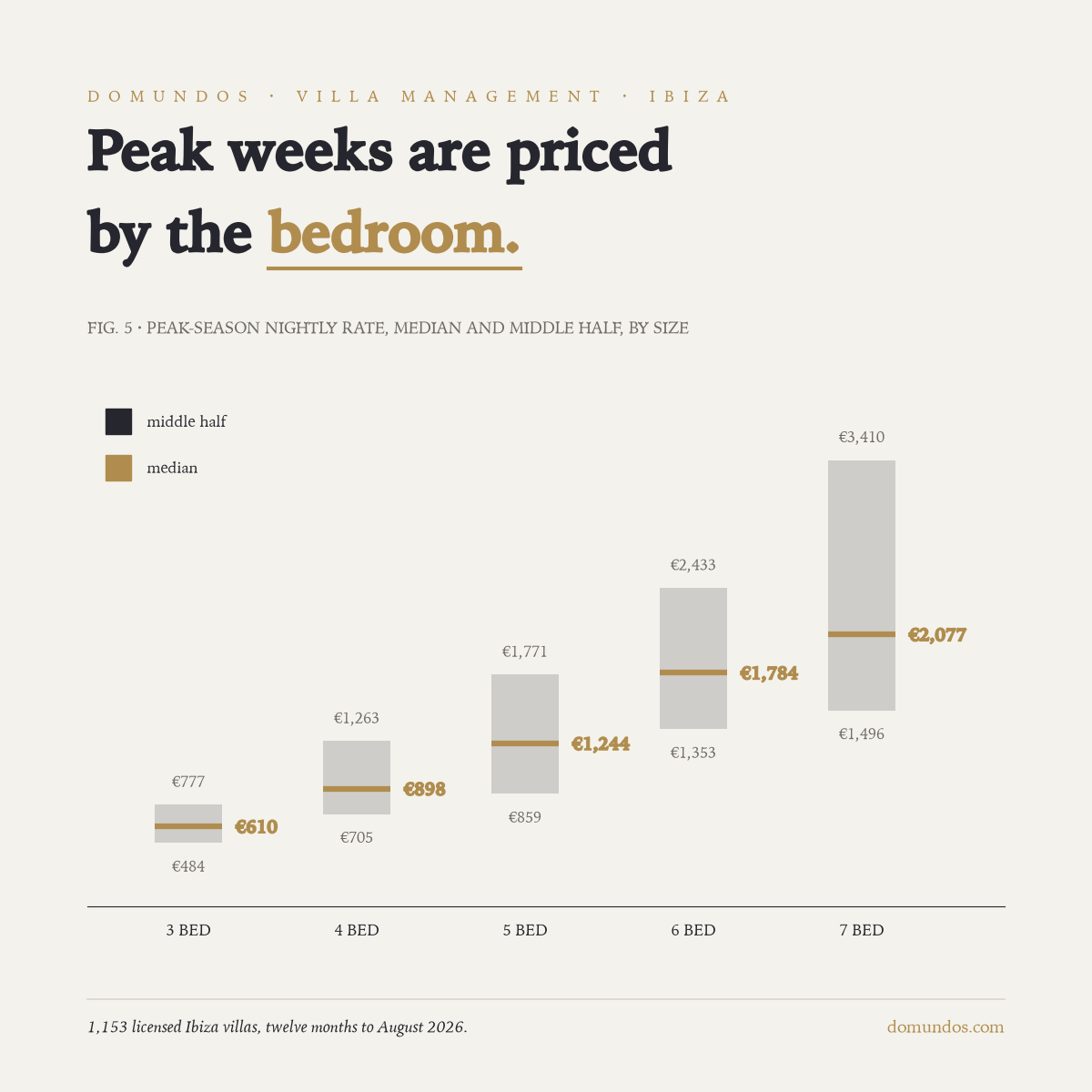
Rate positioning has a data floor and ceiling. Across 1,153 licensed villas the median peak-week rate in 2026 was €898 a night for four bedrooms and €1,244 for five, with the middle half of the market running from roughly a quarter below those medians to a third or more above. A villa priced under that band in March is not competitive; it is handing the top quartile to someone else. The full ladder by size is in Ibiza villa rental income and ROI.
Ibiza’s demand curve is not uniform across the summer. Specific weeks in July and August command a scarcity premium that a well-positioned villa can capture aggressively. Shoulder weeks in June and September, and extended shoulder-season months for the right locations and villa profiles, require a different strategy: lower rate thresholds, flexible minimum stays, and sometimes incentive structures that make a five-night booking more attractive than leaving the week empty.
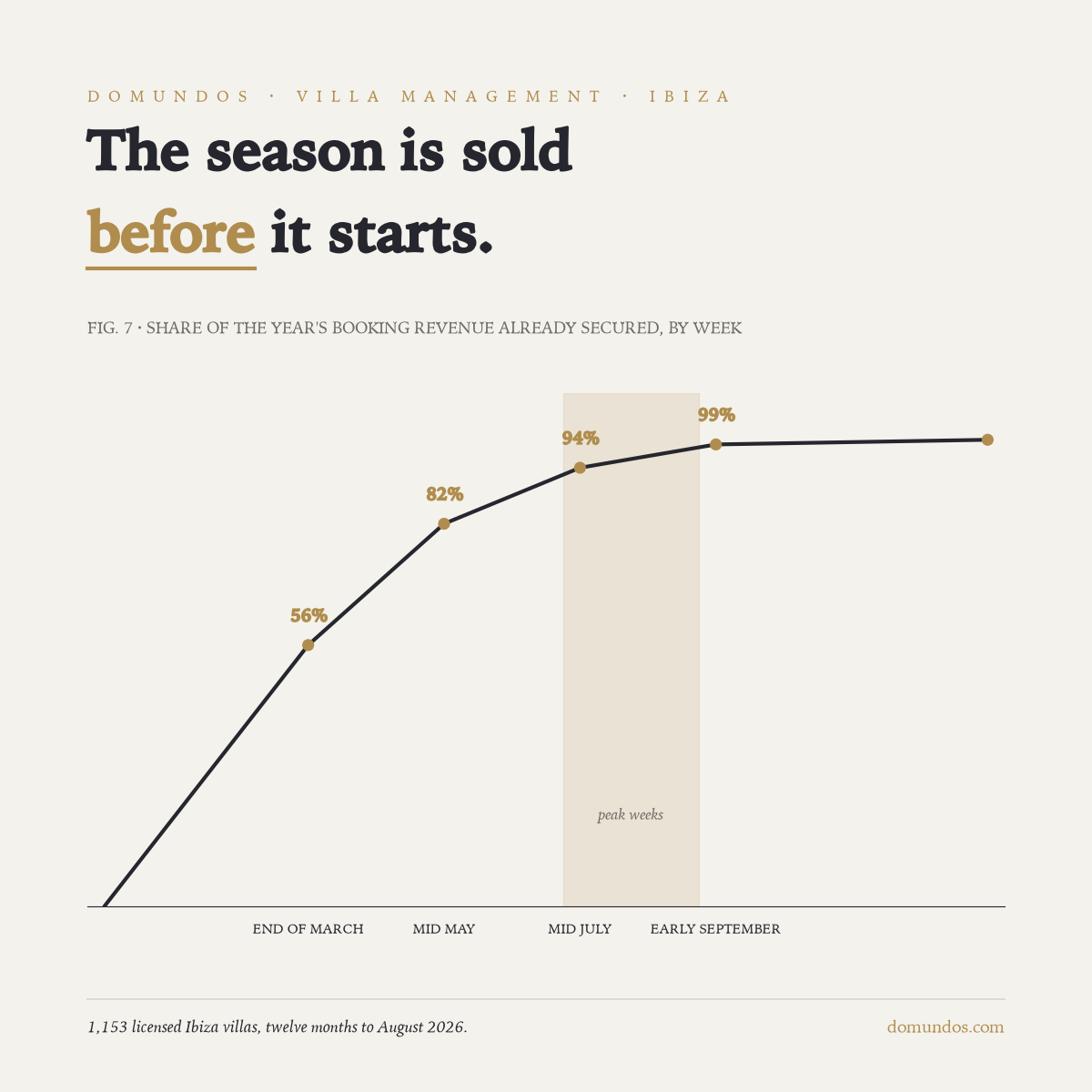
The calendar shows how early those decisions are made: 56% of the year’s revenue is booked by the end of March, 82% by mid-May and 94% by mid-July. Marketing that goes live in June is competing for the last 6%, and in 2026 that last-minute share was harder to fill than in any recent season while early bookings held their rates.
Dynamic pricing means actively monitoring bookings pace, competitor availability, and demand signals, then adjusting rates and minimum stay requirements accordingly. A villa that is 80% booked by March should probably be raising rates for its remaining availability.
A villa with significant July gaps in May should be reassessing whether its rate positioning is correctly calibrated to what the market will pay.
Minimum stay policies interact with pricing in ways that owners frequently underestimate. A rigid seven-night minimum from Saturday to Saturday is operationally clean but commercially costly if it generates inventory gaps that cannot be filled at short notice. More flexible minimum stay policies in shoulder weeks, combined with gap-fill pricing for short breaks, can add material income with minimal operational disruption.
The owners and management companies that price well do not set it and forget it. They treat the booking calendar as live commercial data, read it on a weekly basis during the active booking season, and adjust continuously rather than in large occasional steps.
Reviews: The Marketing Asset Most Owners Under-Manage
Reviews are not feedback. They are marketing collateral that a guest writes on your behalf, read by every prospective booker evaluating your villa against alternatives. A consistent set of strong recent reviews does more to convert a hesitant enquiry into a confirmed booking than almost any other single element of the marketing mix.
The platforms know this, which is why review recency and volume directly influence search ranking on Airbnb and Vrbo. A villa with thirty reviews averaging 4.8, the most recent from last month, will rank meaningfully higher and convert meaningfully better than a villa with fifteen reviews averaging the same score but the most recent from eighteen months ago.
Generating reviews requires an active process, not a passive hope that satisfied guests will post spontaneously. The most effective approach is simple: ensure the guest experience consistently exceeds expectation, then make the review request personal and frictionless: a message from the management company that thanks the guest by name, references something specific from their stay, and makes it easy to post in under sixty seconds. Guests who had a good time will generally leave a review if the moment is handled well. Most managers do not handle it well.
Handling negative reviews is the more commercially sensitive skill. A negative review that goes unresponded to signals management indifference. A defensive or dismissive response makes it worse. A response that is calm, specific, acknowledges what was legitimate, and describes what has been addressed converts a liability into evidence of professionalism. Prospective guests read negative reviews specifically to assess how management responds to problems. A well-handled response can turn a three-star review into a net positive for the villa’s image.
Social Media and Content: Worth It for Some Villas, Overrated for Most
The advice that every villa needs an Instagram account, a consistent content strategy, and a growing follower base is largely wrong for most properties. The return on effort from organic social media for a private rental villa is structurally limited. You are not a hotel brand with inventory to fill year-round, and your target audience is a relatively small group of high-value bookers, not a mass consumer audience.
Where social media earns its place is at the luxury end of the market, where brand positioning, visual aspiration, and direct enquiry generation can justify the effort, and for villas with a genuinely distinctive story to tell: exceptional design, unique location, history, or a management narrative that builds trust with high-value clients. In these cases, a well-maintained Instagram presence with professional imagery, used primarily as a visual portfolio and trust signal for guests who find the villa through other channels and then research it, delivers real value.
For most villas, the better investment is in the fundamentals: excellent photography for the main listing platforms, a clean and credible villa website, and a managed review strategy. These convert the bookings that social media aspires to attract.
How Platforms Interact with Regulatory Authorities
One operational marketing reality that owners and management companies need to be clear on: the platforms are no longer passive distribution channels indifferent to legal compliance. Both Airbnb and Vrbo now require ETV license numbers on Balearic listings, and there are active mechanisms for cross-referencing listed properties against the licensed property register. Listings without valid, matching license numbers are subject to removal, and the platforms cooperate with regional authorities in a way that was not standard practice five years ago.
This means that a marketing strategy built on unlicensed distribution is structurally fragile, not just legally exposed. A listing that can be removed at any point, by platform action rather than by enforcement process, is not a reliable commercial channel.
What Good Marketing Actually Looks Like in 2026
The marketing playbook for a well-performing Ibiza villa is not complicated, but it does require consistent execution across several elements simultaneously: excellent photography, multi-channel distribution with a deliberate weighting toward higher-margin channels as the villa matures, dynamic pricing managed on a weekly basis, an active review generation strategy, and a compliant licensing presence across all public listings.
What it does not require is complexity for its own sake. Owners who chase every new platform, invest heavily in social media strategies unsuited to their villa’s profile, or restructure their distribution every season based on the last conference they attended tend to produce inconsistent results. The villas that outperform year on year are usually those where the fundamentals are executed with discipline, and where the management company running those fundamentals has the local market knowledge to know what the demand signals are saying before the season opens, not after it closes.